Saturday, 7 June 2014

Beowulf versus Grendel - the Rematch!

With the recent publication of J R R Tolkien's 'lost' translation of the saga and a major exhibition at the British Museum dedicated to Viking life and legend, Remy Dean looks back over the life and times of Beowulf - our first 'novel' - and asks, "Was Grendel a 'green' warrior, wrongly vilified?"

Beowulf is a true classic, the most important piece of Olde English literature to survive from the Anglo-Saxon period. The story is set during a much earlier era, the action taking place in fifth century Scandinavia against a backdrop of political intrigue, feuding, feasting and fighting amongst men and monsters.

The original author and precise date(s) of origin remain open to conjecture, though it was certainly set down, in written form, in pre-Saxon Britain, though possibly as a series of separate stories later compiled around the central theme and adapted to take in the influence of Christianity. It is generally thought that many elements of the story had been passed down from the scalds, bards of the Norse, as there are themes and conventions in common with the great Viking sagas such as those of the hero Sigurd.

The surviving version of story as we know it, is thought to date back to the early eighth century, later being recorded as one manuscript toward the end of the tenth century, almost certainly by a monk or religious scribe of some kind. The original poems, from which the story is derived, could date back as far as the fifth and sixth centuries, contemporary with when the action is set. The only surviving manuscript is 1,000 years old and only narrowly escaped being destroyed by fire in 1731, when held at the Cotton Library. It is now preserved and displayed at the British Library, who have also made an e-version available on-line.
A page from the one and only Beowulf 
Beowulf is not only the oldest story set down in English, but also in the whole group of Germanic stemmed languages and is important as a major landmark in the development of literature, yet striking in its apparent modernity - the story is a quintessential heroic epic, jam-packed with action and adventure. Although tinged by the Christianity of the time when it was set down with quill and ink, Beowulf is a tale of heathen warriors, old gods and ancient monsters. The central hero is the Beowulf of the title. The story joins him as a young aspiring warrior and follows his life from that point on as he triumphs over seemingly insurmountable odds that have repeatedly defeated and slain lesser men.

There are three pivotal confrontations, or trials, that punctuate our hero’s life. First, Beowulf takes on the formidable Grendel, a creature of natural and supernatural power that has been terrorising the court of King Hrothgar. After defeating Grendel in combat, Beowulf is then faced with the onslaught of the beast’s mother, whom he also defeats after a metaphysical journey into the earth to seek her subterranean lair. The third and final confrontation occurs some fifty years later when a mighty and fierce dragon, a firedrake from the north, becomes Beowulf’s nemesis.

Beowulf was not written by a single author, it stems from the age of the storyteller, where a tale would be told and re-told, adapted to the audience, elaborated upon and passed down to the next generation as oral tradition. Each storyteller would add their own personality, experiences and style, emphasis may shift according to political climate and contemporary events. Beowulf is a tale filled with the drama and poetic artistry gleaned from generations of performers who have spoken and sung its verses. It is the earliest, long story to make the transition from this bardic tradition of story-telling and story-singing into the written form. It could be considered the earliest example of the novel.

Beowulf is a well-known work, though it has not, until recently, been widely read and had remained the preserve of scholars. Some small sections and verses from Beowulf were translated into 'modern' English in the early 1800s, but the very first ‘accessible’ translation of the full text, from the Olde English, was into Danish in 1820. This was followed, some years later in 1895, by a translation into contemporary English by William Morris. Probably the person most responsible for the poem coming to the attention of a wider audience was Professor J R R Tolkien who drew heavily from it for his Lord Of The Rings sagas and presented a lecture to the British Academy in 1936 titled, Beowulf: The Monsters and The Critics. He had also written his own translation of the saga in 1926, though this remained unpublished… until now.

The Beowulf story itself remained hard to get to grips with until an excellent translation by Michael Alexander was broadcast by the BBC and published in the Penguin Classics series in 1973, to be reprinted almost every year for the following decade. This version goes out of its way to convey the ‘barbaric splendour’ and ‘sustained energy’ of the poem and is accompanied by an extensive introductory essay that points out that a textual translation can never by completely faithful. Old English ‘scopas’, and the storytellers of yet older traditions, would certainly have spoken the piece, or even recited it in song to the sound of harp. Alexander concludes his intro by saying, ‘While I cannot expect readers to sing, I hope they will read the verse aloud. Beowulf was not written to be readable but to be listened to’.

Then here is one scholarly editor who may well approve of the treatment the story received at the hands of eighties rock giants 'Marillion' in their monumental track, Grendel. The song is a 17 minute rock opera that tells the story of Grendel from the monster’s point of view, where he is the ‘good’ primeval force of nature and the Viking ‘heroes’ are the villains, with their lack of respect for the land and for their fellow humans, whom they slay by the hundreds in ‘noble battles’.
Fish fronting 'Marillion', circa 1983,
takes on the mantle of Grendel
Though the song is greatly respected by the fans, Fish, the lyricist responsible for the Grendel song, does not feel that it deserves the high esteem in which it is held, “It’s a song that has gathered a lot of weight through the years that I don’t think is really justified,” admits Fish, “The whole Grendel thing came about because I was given huge slab of music and we needed lyrics for it. I had to come up with a conceptual piece that was gonna tie it together, that was grand enough to lay over the top. At the time I had read a book, it was just called Grendel, by John Gardner - I was given it when I first joined 'Marillion'…

“Gardner completely re-wrote the whole thing from the monster’s perspective,” Fish explained, “The humans were actually the more evil of the two. Grendel had been on the planet from ages before - it had a lot of ecological roots in it - and I took that from his book. What can I say - it was a very early piece of writing and it stands on its own, but, y’know, it’s not what I’d have carved on my tombstone! To me it’s a nice wee slice of nostalgia.”

Grendel is currently available on the compilation album B'Sides Themselves... you can watch a wonderfully theatrical live performance of Grendel from 1983 - on YouTube - and you can read a longer Scrawl interview with Fish here... )

The Grendel section of the story seems to be the piece that most effectively captures the imagination of the modern creative and was also the plot focus for the film, The 13th Warrior, adapted by Michael Crichton from his own novel, Eaters of the Dead. Though Crichton has said that the plot is based on the journals of Ahmed Ibn Fadlan, played by Antonio Banderas in the film, it is undeniably an adaptation of the Grendel story thread - and a pretty faithful and effective one at that.

Ibn Fadlan was a Moslem emissary who travelled with a group of Vikings through the Europe of 922 and who was, “astonished by their lustful aggression and apathy towards death”. In his journals, according to Crichton, the leader of the warrior band is named ‘Buliwyf' - which does sound pretty similar to ‘Beowulf’. What Crichton has done, is expertly fuse the historic facts of one source with the poetic power and drama of another, thus creating the most accessible portrayal of the Grendel arc so far, as well as one of the most intelligent action movies of 1999.

There are some interesting takes on major scenes from Beowulf, for example, the strange ribbons of fire that look like serpents across the land are interpreted as vast hordes of horsemen bearing torches and riding in columns. Grendel himself is represented as one particularly fierce warlord among a vicious tribe who don paint and animal pelts before a raid. Grendel’s ‘mother’ is their pagan priestess and the supernatural magic is the stealth and tactics they employ, and perhaps the effects of certain ‘herbal’ substances - both on the raiders and their victims.
Ibn Fadlan (Antonio Banderas) has yet to earn the respect
of Buliwyf (Vladimir Kulich) in The 13th Warrior
One interesting piece of re-casting is the narrator being of Arabic origin, rather than a Christian Brit. In the movie, Buliwyf asks Fadlan if he can, ‘draw sounds’, meaning to record speech in written form. It is generally accepted that the runic alphabet was brought to the Vikings by a traveller, who became known as Odyn in their mythology, later being elevated to the status of a god. The journey and development of the runic alphabet can be traced back through Europe to its origins in the middle-east.

It is also worthy of note that the personage of Odyn is referred to as ‘grim’, meaning hooded, and ‘dark’, possibly because he was of a middle-eastern origin and would have had dark hair, eyes and complexion compared with the redheaded and blonde-haired, pale or ruddy complexions of the Nordic races. His garb was also unusual enough to warrant comment.

The 13th Warrior was not the success that may have been expected from, John McTiernan, director of blockbusters such as Die Hard, and passed without being noticed by many who could have appreciated its content on the level at which it was intended, instead garnering luke-warm reviews and even a few hostile ones from mainstream critics who could not see beyond the rim of their tub of popcorn.

In contrast, Seamus Heaney’s translation of Beowulf, published the same year, was well received by the critics and did make it into the best seller lists. This most recent translation was also released as a talking book edition, read by the poet with his expressive Irish lilt. This form best suits the work, so it is unfortunate that the spoken version has been abridged for release, though it remains a very enjoyable and certainly a most accessible rendition.

You can listen to Seamus Heaney reading his translation of Beowulf: part one and part two
...or you could read his translation in text for yourself here.

Four further films have since tackled the task of re-telling the classic tale. A fairly low-key (not Loki) historical drama treatment, Beowulf and Grendel, was filmed in 2005 against the moody backdrop of Icelandic landscapes. This was a solid attempt at a more naturalistic, performance-driven interpretation with Gerard Butler as Beowulf and Ingvar Eggert Sigurðsson as a more ‘homo-simian’ Grendel.

Then, in 2007, there was the pioneering CGI Hollywood epic version of Beowulf, starring a ‘buffed-up’ Ray Winstone in the central role of the ‘larger-than-life-but-authentically-flawed’ hero and an interpretation of Grendel portrayed as, hideous – yes – but also a sympathetic victim to some extent – an unfortunate outsider, unable to comprehend the hatred and revulsion he inspires in others. The role of Grendel’s mother was given a seductive makeover in the form of Angelina Jolie as the Sea ‘Hag’.
Beowulf confronts Grendel's mother, the 'Sea-Hag'!?
Also in 2007, possibly to ride the bandwagon of the bigger budget movie, Grendel  was back as a straightforward villain in a made for TV monster-movie, Grendel: The Legend of Beowulf, that puts aside any real trappings of historical accuracy in favour a being a CGI powered romp… the Vikings even wear the good old horned helmets (which they did not really do). It is a bit of monstrous fun, if you are in the right mood, and the visualisation of Grendel is closer to how he was described, or at least hinted at, in the original text.

More recently, in 2008, Outlander introduced a ‘futuregoth’ theme in a clever re-imagining of the tale. A crashed space ship brings the hero and an alien menace that will fulfill the role of both Grendel and the Firedrake. Again the villain is shown as sympathetic, one of the last few of an alien race that were dreadfully wronged and now seek understandable vengeance. Yet its jailer-custodian cannot allow that wrath to be vented on the unsuspecting Viking villages of Earth, and so steps in to defend their inhabitants.

Cinema is not the only transmedia journey taken by our ancient hero… in 1975, probably spurred on by the huge success of the Penguin translation, DC Comics launched, Beowulf: Dragon Slayer, a typically camp and musclebound interpretation of the saga. Well almost. The comic soon veers away and leaves very little in common with the original epic. There are horned helmets and bikini clad maidens left right and centre, and also a whole array of international, cross-cultural monsters for Beowulf to slay – it seems he will travel far and wide to avoid, or at least, postpone his confrontation with Grendel!

Produced in 2008, the slim graphic novel, Beowulf: Monster Slayer, adapted by Paul Storrie and illustrated by Ron Randall, is a bold attempt to compress the poem and render it more accessible to younger readers, which it does fairly well… Though produced around the same time, Gareth Hinds' three volume Beowulf is the most successful graphic adaptation to date.

Each volume tackles a main segment: Beowulf versus Grendel in book one, takes on his mother in book two and defeats the firedrake in the third volume before being proven to be mortal himself. These books are now available collected in a single volume.
Beowulf graphically retold by Gareth Hinds
There have been other graphic re-tellings of the legend and most are listed here, with some samples of artwork.

…and so the story of Beowulf continues to capture the imagination of readers, and viewers, to this day - perhaps this is because the story operates on a number of levels. It is obviously an action adventure, heroic epic and ripping yarn, but it is also a symbolic parable that reflects not only the trials and triumphs that beset Beowulf throughout the journey of his life, but those that have continuously confronted all human endeavour on both the physical and spiritual levels.

If you are interested in the reality behind Viking life, then there is currently (until 22 June) a major exhibition at the British Museum that you should take time out to visit – more information and some on-line resources here.
Enthroned Odin - small silver piece currently on display in the
British Museum's Vikings: Life and Legend exhibition

Monday, 2 June 2014

Aaron Stainthorpe - Brought to Book

What was the first book you can remember reading that really grabbed you and carried you along?

My first clear memory of any palpable literature was the debut by William Golding, Lord of the Flies. Naturally, at the age of 10, I didn’t fully embrace the book's theme of a new civilization but loved the idea of a bunch of kids messing around on a desert island with no adults telling them what to do.

Do you have a favourite book, or one that you have re-read a few times?

I have two actually: Cryptonomicon by Neal Stephenson and, in total contrast, Guards! Guards!, by Sir Terry Pratchett, the latter of which I have enjoyed three times... but Neals’ is so vast that a second visit has not yet been planned.

What was the most recent book you read and thoroughly enjoyed?

Whacky, intelligent and thoroughly gripping is how I’d begin to describe the Adam Roberts book Land of the Headless. Beautifully written it tells of a wild notion of decapitation as punishment but without the terminal effects that you’d expect!

Who have been your favourite authors, and what have you learnt from them?

I’ve loved Pratchett for 25 years and although I can’t say I’ve learnt that much from his musings I have certainly gained a lot from them. Adam Roberts is my latest target at this moment in time. As well as the above mentioned I also nailed Salt, Swiftly, The Sellamillion and The Soddit and am currently reading Splinter. What have I learnt from him? Anything goes!
Aaron Stainthorpe delivers the doom
Do you have a writing ritual, regimen or a tried and tested process?

I take notes when something appeals - I always have pen and paper - whether I’m out doing menial day to day tasks or walking in the hills and forests of Yorkshire. If I’m inspired by movies, music or art I’ll make a little note of just what it is that turns me on about that special moment in time and add it to my archive of seeming gibberish. When I actually begin to write, I really need to be in just the right mood and as cheesy as it sounds I love to write by candle-light while sipping a sanguine red wine, late at night when I can’t be disturbed or distracted by real life. I will refer to my notes and look for a spark to light the fire and hope that the next few hours will deliver and inferno rather than a soggy fire-cracker. Unfortunately, dissatisfaction comes hand in hand with patting-on-back but I can handle that. I don’t read what I’ve written for a couple of days and then return to it in the hope that it’s as I remember in the fuzz of badly lit alcohol.

What motivates you to write?

Passion. If it’s not there then I simply do not bother. In the past I’ve tried to write because I had a deadline and it’s mostly been a disaster so no more. If the heat and fervor are absent then so am I.

How do the different creative formats that you work in ‘feed’ into each other: photography, illustration, lyric, etc?

There have been moments when I was convinced that I was going to create an illustration based on some madness at the back of my mind and during the process I’ve lost my way or couldn’t get the image just right so I change format and begin to try to write my vision instead, which luckily often works rather nicely. And it works the other way round too. I’ve binned pages of lyrics because of their lack of cooperation and chucked oils at a canvas, popped another Chateauneuf-du-Pape and wondered why it was sunrise already! My lyrics and illustrations are thoughts manifest but my photography is more pleasure and observation – a lovely way to spend a carefree afternoon without tormenting myself.

Aaron Stainthorpe is the lead singer and lyricist for 'My Dying Bride', the British ‘Doom Metal’ band who have defined the genre over the last twenty years or so, successfully bringing the graveyard school of Romanticism back to contemporary cultural relevance. Although they may have their imitators, they have continually innovated and maintained their distinctive sound and originality. Typically, a 'My Dying Bride' album will have moments of lush overindulgence, bursts of startling brutality and a haunting fragile beauty… A butterfly braving the storm. As a backdrop to Aaron’s literary lyrics, the guitar work can be as heavy as hell one minute but poignant and heart-rending the next. The songs are fleeting poetic ideas framed by evocative soundscapes or epic stories told in verse illustrated by a mix of complex textural atmospherics, heart-pounding riffs and symphonic strings.
an epic tale told in song...
In order to appreciate the power and variety of Aaron’s storytelling we recommend the following ten tracks (listed in reverse chronology):

The Barghest O’Whitby 
...from A Map of All Our Failures: A Tapestry Scorned and Hail Odysseus 
...from A Line of Deathless Kings: And I Walk With Them, The Raven Wings
...from Songs of Darkness, Words of Light: The Wreckage of My Flesh and The Blue Lotus
...from The Dreadful Hours, the title track and My Hope, the Destroyer
...the title track from Light at the End of the World

- Aaron Stainthorpe was talking with Remy Dean

Thursday, 29 May 2014

Jonathan Meades en catimini

In this extended interview feature, Jonathan Meades talks to Remy Dean about writing, painting, concrete poetry, and Blaenau Ffestiniog…


Who is Jonathan Meades? He is that man on the telly, who always wears dark suits and talks about stuff you think would be boring but turns out to be really interesting. He performs intellectual acrobatics around a theme and continually re-routes the train-of-thought, sometimes derailing it completely and though you may sometimes feel you are losing track, your train-driver never does. You start out somewhere familiar and soon you have been transported, along with this delightful and well-informed travelling companion, to some surprise destination.

I recall the profound quote from T S Elliot’s The Waste Land, as quoted in the movie The Magus, which was based on the novel by John Fowles and starred Candace Bergan, Anna Karina, Michael Caine and Anthony Quinn:


We shall not cease from exploration 
And the end of all our exploring 
Will be to arrive where we started 
And know the place for the first time.

This is what Meades facilitates, a meaningfully guided exploration through what might seem mundane towards something that begins to feel magical and when we return to normality, the familiar has become once more fascinating, something much more grotesque and/or beautiful.

Meades is our Media Magus. Indeed he must be working some sort of magic to get his work produced for television. It is difficult to imagine how he might pitch his ideas to producers more usually hungry for increasing viewing figures or sensational tabloid responses… Consider these titles: The Utopian Avoidance of Right Angles, The World of Caravans, The Architecture of Beer, Postwar Churches, The Fens, The Joy of Essex… well, I would want to watch all of those - and the rest of his oeuvre - but I would not have a clue as how to sell these titles to a television producer!

“Well, I have the advantage of having been at it for a long time,” responds Meades with a fatherly tone of encouragement, “I did my first BBC series 25 years ago. I had done a one-off for the BBC before that, and I had done a Channel 4 series before then. So it would not be the same for anyone coming in and trying to do it now – but I still have quite considerable difficulty getting things off the ground. The reviews get better and better and the time I am allotted gets smaller and smaller… but people in television tend not to take any notice of reviews. It’s very, very insular, inward looking, I mean like a verruca – not like a wart, that grows out into something new, more like a verruca that grows inward.”

So, does he suggest that, just perhaps, television companies in general - and the BBC in particular - could be more interested in building internal power structures than in pandering to audiences?

“For example this pathetic nobody called James Harding who had the temerity to criticise Jeremy Paxman - when Paxman said that a lot of the BBC is absolute shite - this little fool rapped his knuckles like some sort of prefect at school… and that is not atypical, it’s pretty much a world that is full of fear and people looking over their shoulders, not wanting to offend. I rather agree with the attitude of Joe Orton and Kingsley Amis that unless you’re offending someone, you’re not doing your job.

“I certainly don’t pander to audiences, I make shows that I want to see, and when I write, I write prose that I would want to read. I mean, you are your own first reader, after all. So I make stuff to please myself, and hope that it will also please a certain audience, and it appears to – I mean, it’s not very large audience…. but that is a self-fulfilling prophecy, when I was on BBC2 I used to get two-and-a-half to three-million viewers, I only get a tenth of that on BBC4, because that is the nature of BBC4. Frankly, I don’t really care – I’m not after viewing figures, I’m after programs and films that please me and please the people I work with.”

Something oft debated, with my students in art history classes, is the question of which is more valid: a piece of work that millions of people think is ‘OK’, or a piece that only a few people respond to, but passionately and on a much deeper level? Generally, to appeal to more people you have to serve a lower common denominator, though true excellence and quality is sometimes, sadly not so often, recognised by the masses.

“My stuff is implicitly critical of television as it is now,” explains Jonathan, “Television used not to be as openly moronic as it has become...

“Obviously, things that appeal to millions of people can be very good, but there is an awful lot of populism which is second-guessing what people are going to like, yet there are lots of unsuccessful light entertainment programs, lots of unsuccessful airport novelists. The thing is that television is so institutionalised that it is very loath to try anything new or to make a program about a subject that has not been covered before. It is very loath to take any risks… and when you think how fantastic it was twenty / twenty-five years ago: we had Denis Potter, Peter Nichols, David Mercer, David Perry, David Rudkin, Tom Stoppard – really good writers writing specially for telly. Whereas now, it has become absolutely formulaic, with very occasional exceptions. I imagine that British television is going to have to react in some way to the success of things like Breaking Bad and The Wire and Lilyhammer and those Scandinavians.”

Yes, those colour-drained crime dramas from the northern lands…

“I don’t think Scandinavian shows are quite what they’re cracked up to be but there is nothing, nothing, made in Britain which is remotely that standard… And television is a great medium. But it has been hijacked by morons.”
RIP - Do you remember Charlie Drake!?
Could this be, at least partly, behind the symbolism of his ‘trade-mark’ dark suit, black tie, dark glasses - the contrived look that rather resembles the garb of an undertaker – a subject examined in his novel The Fowler Family Business – is Meades, as our Media Magus and Social Shaman, presiding over the funerary rites of our cultural programming pride?

“There isn’t anything symbolic about it." (Was that a chuckle?) "I want a constant look in those films, and there have been very few when I haven’t worn a dark suit and dark glasses and so on… There is one when I didn’t because someone spilled coffee all over my suit just before I was about to start, so I wore a tweed jacket for that one, which was in Aberdeen… but the suit differentiates me from the few other people who are around and the landscape or streetscape. It turns me into something that may have landed form and alien civilisation. It’s as simple and practical as that. 

Jonathan Meades stands out

“I worked it out. It wasn’t something that I came to by chance, I wanted to do television which was, as much as possible, a kind of one-man-show - performance art as well as being informative, educational, entertaining… and I determined to have that particular look, which I’ve never changed. I hope that it seems like I have come from, elsewhere and I’m very detached from what is around me. Equally, I remember going to see Michel Sardou in concert, a French singer, and he was brilliant on stage. He didn’t do anything, he just stood there absolutely stock still and I found that very impressive.”

Meades manages to be a very detached, yet very human presence throughout his documentaries. In the introduction to the DVD collection he explains how he consciously avoids the TV presenter clichĂ©s, always speaking deliberately and eloquently with a very deadpan delivery, so much so that sometimes I get the idea that, just at the point of the edit, he or the cameraman burst out laughing…
Past Presenter... a memento of Meades TV
“No. Not often, no. The scripts are very written. It is a literary project as well as a visual one. A lot of people who present things on television aren’t writers, they have scripts put together by producers and researchers and so on. What I do is write a very detailed script then give it to the director, who is nearly always Frank Hanley, who is a great friend of mine. Once Frank has got the script I don’t question anything that he does. I do write in a lot of shots and suggestions. But basically after I have written the script, then I am there as actor-performer.”
A collection of writings including scripts
So the script is of utmost importance here – the words come first. Meades takes great care and puts in the time and effort at the writing stage and thus the rest works out well when interpreted for the screen. So is there a particular approach to writing, a regimen, a Ritual? Or does he just get up, have a coffee and croissant and get on with it.

“I haven’t had a croissant for a long time, very rarely have a croissant… Ritual?” he seems to consider this for a long moment, “No. I just go to work. I get up and I sit down at my computer and start work. I work till lunch time, then do sort of admin things in the afternoon and then, late afternoon, I start writing again. I write very specifically for whatever medium the work I am doing is going to be in. I don’t really believe in synergy between different mediums, I don’t think it works, I think you have to write absolutely specifically. If I am writing for television, it is absolutely specific to television and equally I don’t think my new book or any of my books are particularly adaptable. You could do a version of them but they aren’t written with a view to being re-done.”

So, when he is writing a novel he does not have one eye on the film rights, or TV series?

“Absolutely not, I mean when you take a novel and make a film of it, all you’re left with is the plot, the story and the characters to some extent – you have an element but you don’t have the prose, the nuances of language. I find it rather difficult to understand why there is – always has been – such a reliance on stuff from different media in the cinema. It is a kind of lack of confidence in the power of cinema and similarly in the power of television.

“Y’know this new arts directive announced by the current director general of the BBC is basically TV abasing itself and telling itself that it is not as authentic as theatre or opera or symphonies, and so on – that TV is just a means of transmitting those cultural forms to a bigger audience. That is not right: what TV can do is to create a kind of television that is peculiar to the medium… It is what the writers I mentioned used to do. It is not a poor man’s cinema. It is not radio with pictures. It is something of itself. That is what I, obsessively, try to do… and will sooner or later give up doing because it becomes such a slog!”

So when he does ‘give up’, or if he were to retire – I would very much be interested in the job description used to advertise the vacant position. The most common description of Jonathan Meades seems to be ‘writer and broadcaster’ – I’m not sure it that really covers it.

“I hate the word ‘broadcaster’… I am a… writer and… er… writer. I write books, I write journalism, I write films. I appear in those films but I wouldn’t call myself a ‘broadcaster’ – it’s a deathly sounding word, some terrible fool waving his arms around and speaking a script that’s been written by someone else.

“It’s not my job to classify myself – I do a variety of things. I don’t think about how I should be described. It’s up to other people…  I’m not really mad about talking about myself.”

Your new book is all about you…

“It’s not actually, although the title would imply that. It’s much more about my parents and my parents’ generation.”
What's it about, Jonathan?
So An Encyclopaedia of Myself is more of a history book in a way?

“Yeah, it’s a kind of scrutiny of provincial life in the 1950s – it’s very petits pois, very detailed. It is only marginally about me. I’ve only seen the one review so far, in The Sunday Times, which gives the impression that is totally about me – it is not. I am a viewpoint. I am a camera looking at things, I don’t particularly engage…”

Here’s another review from The Guardian

Perhaps Meades tries not to dwell too much on himself, yet it is his individual take on the subjects he addresses that make him such an asset. He, himself, is the lens that brings many original ideas and fresh views into focus. It has been said that any artist can only ever produce a self-portrait…

“I think that’s true. What Alain Robbe-Grillet said, ‘I have never written about anything except myself.’ People often think there is something distant and objective about his books but there is not and when you realise that, you read them in a different way. It’s more acknowledged in painters than it is in writers, that they have their mark their signatures – you can tell a Cezanne from a Mondrian, I hope. It is evident with painters and I think much less so with writers."

Is there talk of a television series based on An Encyclopaedia of Myself?

"No – it wouldn’t transfer. I mean someone could dramatise it – I could dramatise it, some bits of it – but it is a completely different thing. I have made one or two television films that are autobiographical, one about the places I went to with my father on his rounds selling biscuits in small towns in Hampshire and Dorset and Wiltshire.”

Were those travels with his father responsible for his fascination with how communities were tied together by the way people spoke and the places those people shared familiarity with as a little clan… Within the virtual architecture of video games and our digital viral lives across social media, are we perhaps leaving those little regional differences in the nostalgic past?

“I think that tribalism still exists in Britain. People have regional accents and there are huge regional differences in Britain. Which is something I am so interested in that I wanted to do a series of films about it, but the reaction was, ‘you’re kidding yourself if you think there are these great differences…’ but I think there certainly are. The differences between Newcastle and Plymouth are massive, even down the East Lancs from Liverpool to Manchester – totally different cities.

“Thirty or forty years ago, that tribalism was perhaps disappearing, but it has come back in a very big way. You hear strong regional accents much more than you did for a time and that’s fine. Of course what is not fine about regional accents is the kind of hierarchy that if you have a West Country accent or a Brummie accent you’re not going to get anywhere in life – you have to get rid of it, but that’s not the case with Irish accents or most Welsh accents… Scottish accents or English accents – they’re all OK… but anything with a rural twang, sort of Somerset or Norfolk is deemed unacceptable. There is something very wrong with that – as there is with most hierarchical systems.”

Many people would assume that Meades comes from a privileged upper-class sort of background, but it seems that his childhood at least was quite humble... a working class background?

“Not working class, no, sort of lower middle-class. I mean I would have been entirely state educated if it had not been for my mother having a very rich great uncle. An extraordinary guy. A gay accountant. Basically a gambler who had made a fortune during the depression because he knew how to work stock markets that were constantly falling. So he had made a lot of money and retired at the age of forty with his boyfriend who he called his valet and he used to design outrageous chauffeur uniforms for him. They lived in Dublin, which was apparently a much better place to live if you were gay in those years – there was less persecution of gay people. They used to come to England about once a year in their Rolls Royce and Frank the valet would sit there completely mute, looking like something out of a musical comedy. And he offered to pay the fees for me to go to this really rotten school – really horrible, horrible school – where I felt really out of place because all the other people had fathers who were solicitors, army officers or had their own business. But I am not in the least bit working class, though I did have a West Country accent which I got rid of for those reasons we already discussed. I didn’t sound like Mike Channon – My God Almighty! A huge seagull – just flew towards me. I mean enormous – size of a condor – really big!”
I did not see this bird. Was this one of those hallucinations that he has described in this extract from An Encyclopaedia of Myself, something akin to those flocks of malevolent sheep from the dark side, menacing him along school corridors, or does he have a sea view there?

“From the office I’m in, I am looking out towards a range of hills, and on the other side we look towards the sea.”

This, if you have not already guessed, is a transcription of a transcontinental telephone conversation from the southern coast of France – Marseille(s) where Jonathan Meades for the most part resides – and the heart of Snowdonia where I enjoy an uninterrupted view of the three peaks of the Moelwyns range of mountains… He has mentioned that, as a child, little Jonathan used to think the Devil lived in Blaenau Ffestiniog.

“Yes, when I was a child I thought it was really scary – the slate quarries under a slate coloured sky, y’know, it’s quite something.”

Living and working in a rural area, I have to do quite a bit of driving and I still get a kick out of coming down into the Vale of Ffestiniog, through the Crimea Pass, and when it opens up you can see right down the valley, suddenly it is slate as far as the eye can see… it reminds me of approaching castle Dracula through the Borgo Pass.

“Yes, it is fantastic,” He agrees, “When I took one of my daughters there, she was very… surprised. She hadn’t seen anything like it, and there isn’t much like it.”

Your reasons for moving to France have been explained as ‘gastronomic’…

“No. It was just a whim of wanting to move out of London. There are many parts of Britain which I like very much but are impossible to get in and out of London from. I mean, I love Shropshire, but getting to London from Shropshire takes much longer than getting to London from Marseilles… and flying in is probably cheaper than train tickets from Shropshire too. We looked at places there. I remember looking at a place in Clifton on Teme, which is beautiful, Worcestershire west of the Severn… we were looking at a house there and I asked why ever are you selling it? And they said it just takes too long to get here on the weekend. Britain has really terrible transport infrastructure. It is certainly the worst in Western Europe.”

So how is the ‘Englishman abroad’ thing working out – is there a cultural identity that Meades identifies himself with, or is he becoming a cultural collage?

“I identify myself with my self. I don’t think of myself as English or British or Wiltshire or London, where I lived most of my life… That is something that I am not particularly concerned with.”

Yet the ways that environments affect people, how places and the people who live in them are inextricable linked, is a theme that he has returned to repeatedly.

“Oh, yes. Other people, not me – it’s not something that I really think about. I’m not particularly introspective.”

Talking of environments, does he enjoy living in a building often hailed as one of Le Corbusier’s masterpieces?

“Yes I do.” 

The Modern kitchen a Le Corbusier

Was living in La CitĂ© Radieuse, apparently referred to by some locals as ‘The Crackpot’s House’, justified as research for Bunkers, Brutalism and Bloodymindedness: Concrete Poetry – his most recent two-part television exploration?

“Oh, no, much longer ago than that. But the Brutalism programme was something I had been thinking of for a long time – in 1994, I did a film called Jerry Building about Hitler’s architecture, and that alludes to the fact that the bunkers and defensive structures of that regime were the precursors of the Brutalism of the 1960s and 70s and there was a fairly considerable interest taken in them. People rather ignored all of those structures for a long time and then the French writer and theorist Paul Virilio wrote a book called Bunkerology and that was the culmination of his research into bunkers. What he did was start to take photographs of them and publish them in architectural magazines and it awakened quite a considerable interest and so there is that route into Brutalism from the bunkers. His earliest photographs of bunkers were in the early 1960s and his book didn’t come out until the early 1970s. Not a very good photographer it has to be said, but that isn’t particularly pertinent. He designed, with Claude Parent a very bunker-like church of Sainte-Bernadette du Banlay in Nevers, Northern Burgundy.”

Having looked at Bauhaus and Modern architecture over the years, teaching and giving talks about them, I have grown to appreciate Corbusier-style buildings - in the right place. I particularly admire some of the ideas in his Sainte-Marie de la Tourette for example. Concrete Brutalism seems to work well against a rural setting, when counterpointed by rolling hills, or trees and natural dry-stone walling, something to balance the expanses of grey and flat slabs, but too much together in a city centre gets rather drab, oppressive and overwhelming… 

Jonathan Meades likes a bit of Brutalism

“Yes, but he can’t be blamed for what his imitators did. He had thousands of imitators and about five percent of them were good, the rest were rather mediocre. There’s a lot of very bad sub-Corbusien building in virtually every country in the world.”

For a fairly brief part of my childhood I lived in ‘Skem’ (Skelmersdale) one of the 1970s concrete and pebble-dash New Towns, hailed as ‘the future’, the way we would all be living… but did not really catch on, did it?

“Well, some of them did and some of them didn’t. With most of these social housing projects of the fifties, sixties and seventies, you had architects who were extremely well intentioned being undercut all the time by politicians wanting to get things done cheaper. Local councils who were charged with maintaining these places didn’t do so. If you buy a car, you then get it regularly serviced, but these places were not serviced. They were also completely undefended, anyone could walk in and have a piss in the lift, and they did. But it needn’t have been like that. High-rise works very well for the rich – you only have to look at London or New York nearly any big city except Paris - which doesn’t really have a lot of high-rise in the centre and has a different demographic pattern. But rich people always get on very well in social housing because their places are looked after by concierges and janitors and so on and not anyone can just walk in – it’s not a free space, it is a gated community avant la lettre… and those new towns would have worked just as well if that had been noted.”

Architecture is an interest I share with Meades, but I remember this interview is for Scrawl, so I attempt to steer it back to his word-wielding and creative writing. Filthy English is one of my favourite anthologies of short fiction and is a potent and very dark portrait of ‘Englishness’, both the language and the (sub)culture. The stories are sparked by etymological meanings, this in itself is an intriguingly Post-Modern method of approaching literature…

“The title story is,” Meades agrees to some extent, “I don’t think the other stories in the collection are really… the story set in the New Forest - that is based on stuff I gleaned from my mother who taught in the New Forest early in the Second World War.”

He is talking about The Sylvan Life, the second story from the Filthy English collection, in which some of the children wear itchy, untreated wild animal furs as underwear (which is the least of their problems)… Just one example, and not the strongest by far, of disturbing elements in a lot of his fiction… It always has plenty of humour, but a lot of darkness that I think qualifies Meades as a horror writer…
The Horror... The Humour... 
“That’s certainly true, but a lot of it is fact or has been recounted to me. The thing about the children coming to school sewn into furs, that’s something my mother told me, it came with my mother’s milk, so to speak. Quite a lot of the stuff in that book, and in Pompey and Fowler Family Business, comes from stuff that people have told me – I’m quite a sponge – I remember what people tell me.

“For instance the most singularly horrific thing in Pompey is the guy who chokes to death on his own shit. Well, that actually happened… I was talking to a writer friend of mine and he said, ‘A most extraordinary thing has happened – this was in Herefordshire, the Welsh Marches – a guy, who was a local bastion at the chamber of commerce and a magistrate, had this particular predilection for shoving a pipe up his arse and then sucking on it, a kind of self-enema, and he choked to death on it.’ I said to my friend, ‘God, what a gift that is!’ He asked, ‘What do you mean?’ I was talking from the point of view of a writer and I said, ‘Well aren’t you going to use it?’ and he said, ‘Oh no, you have it!’ So I did.
Some good shit...
“There is a great deal of stuff that comes, not from my life, but anecdotally received incidents from the lives of others. A lot of the stuff in those stories is invented, the places almost certainly aren’t. Even when I’m writing about the Congo, somewhere I’ve never been, or Agadir – I’ll have done quite a lot of reading round a subject to try to get it right. Every book swallows hundreds of other books so… if I was writing a book about someone who steals eggs, I wouldn’t read another book about an egg-stealer, but I would read about chicken runs or how to construct them… how you could get grants to build chicken runs after the first world war, and things like that. That’s what I do with my films as well, taking an oblique view, not going directly into the subject but looking at things that are tangential to the subject.”

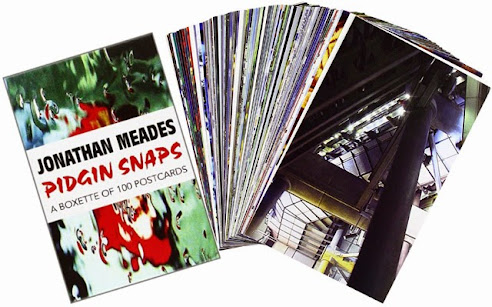
Speaking of tangents, Meades also enjoys working in varied creative formats – I recently enjoyed Pidgin Snaps: A Boxette, his collection of photography presented as 100 postcards (you can read my review here), I know he also dabbles with drawing and painting… 

Jonathan Meades, photographer: a new angle on the familiar

“What the French would call en catimini, which is to say on the sly, with no pretensions. I take photographs fairly obsessively and I do paint a bit. I started taking photographs in car washes, as one does, you get extraordinary effects. Then I started putting liquids of different colours and viscosity into plastic bags and taking photographs of that. Looking at surfaces and making things… so it is all representational but looks like instant abstract expressionism in some cases.

“It amuses me but - I am very perfectionist and detailed as a writer and I will spend hours on a sentence or paragraph getting it right. But with this stuff I do it sort of left-handed and don’t really care what the result is, but in my writing and in my television there is no room for spontaneity, everything is worked out in advance. With this there is a kind of spontaneity that is quite liberating in a way – just messing around."

Some teachers of creative writing do recommend painting and drawing - working with your hands and eyes can bring in fresh creative faculties and get different parts of the brain going…

“Absolutely true it does – what I’ve got left that isn’t atrophied yet – it helps find bits that are actually quite useful which I might not have previously explored.”

Are there any favourite visual artists or ones that Meades finds particularly inspiring?

“They do inspire me, yes, but not to emulate them, but they inspire me, full stop. I find them uplifting: Otto Dix, Christian Schad, Rogier van der Weyden, people who work in extreme detail – though Bacon I find splendid, perhaps the greatest artist of the twentieth century."

You see, I would have thought more Modernist, with his preferences in architecture… Minimalists, Malevich, and Mondrian...

“I’m not very interested in that – I like representational painting really. Pollock and DeKooning leave me cold. I like painters like Edward Burra, one of those eccentric odd-ball English people – not really part of the great canon. I hate this idea of minor painters, or minor poets, I think Burra was terrific. Carel Willink, Dick Ket, and the so called Magical Realists in Holland in the 1930s and 1940s, very interesting – they are rather like the German Neue Sachlichkeit but without the same bitterness.

“I have thousands of postcards, many of them from art galleries and have these weird plastic folders suspended from the ceiling which just show cards on both sides – the one closest to me at the moment has got a portrait of Martin Luther, a painting by Christian Schad, a painting by some Victorian whose name I don’t know, something by one of the Birmingham School who are kind of slightly like Beardsley without the pornographic element, something by a woodcut artist whose work I found in Lubeck, something by Nevinson, another one by Nevinson, a Victorian narrative painting of the Princes in the Tower, something by Patrick Caulfield – very eclectic, I mean I don’t really believe in ‘schools’ I believe in talents. Schools and -isms are quite interesting in a way, but it is just a form of taxonomy which is like when you asked to describe myself – well I don’t.

“It’s like the Nouveau Roman, Alan Robbe-Grillet was fantastic, a great, great artist and writer, but the rest of those people – Jesus, they were so boring, plodding, nothing to say, whereas he was a wonderful kind of poet. I do find it very weird that many architects will say, ‘Oh, I’m a Corbusian’, or ‘I’m a Miesian’, or ‘I follow Lloyd Wright’, for example.

“I find that very strange – because writers don’t think in that way and painters don’t think in that way. They don’t say, ‘Oh, I want to paint like… Constable,’ or, ‘I want to paint like Motherwell,’ – they just want to paint. And for the most part, I don’t think writers sit down and think, ‘I want to be like Stevenson.’ Perhaps when you’re starting off you might – it was Stevenson who said, ‘You teach yourself by being the sedulous ape, you can’t help mimic people until you find your own voice,’ and I think there is truth in that, but afterwards you wouldn’t dream of sitting down and thinking, ‘I’m going to write this paragraph like Fitzgerald’…

“Most creatives are obsessed with trying to be true to themselves, and one way of being like yourself is like what Picasso said, ‘copy anyone, but never copy yourself.’ Picasso copied VelĂ¡zquez - coming out as Picasso of course, but that can be a route into finding a different part of yourself.”

After a writing career spanning three-and-a-half decades, does Jonathan have any advice for aspiring writers?

“Get a job in the city. I think things are worse for writers than they have been for a long time because of things like blogging – which is a form of self-publishing – people are not able to make any kind of living from writing, which can be arduous and takes a long time – perhaps it doesn’t take bloggers a long time and there are different types of blogger, so I don’t know – The old phrase was, ‘Write for pleasure, publish for profit,’ – now its write for pleasure and publish for pleasure."

The ease of publishing nowadays is good in many respects. Power has been returned to the writer and things with limited minority appeal can now be put out cost-effectively, but it also means that we are swamped by masses of unmediated stuff that readers have to navigate for themselves, without the filters of publishing houses…

“Yes, but the publishing houses have always been very fallible – they have no idea. If they get a best seller, they just try to repeat the formula. That’s no different from TV.”

Different is something that Jonathan Meades is. His fiction is certainly not formulaic. His television is far from being run-of-the-mill. His mind has the elements of wonder and curiosity of a young child, and the cutting intellect of a polymath with wide-ranging experiences. He uses words well, though it is hard to sum him up with them…

‘Etymological’ is an interesting word, sounds so much like ‘entomology’ that some people mite (sic) get confused, it’s the word for the study of words, how post-modern and self-referential is that? Of course, Meades would never get confused by this sort of thing, being an expert etymological archaeologist and Media Magus… I wonder does he have a favourite word?

“No.”

No? ‘No’ – that’s his favourite word? (Titles spring to mind for this interview feature: Jonathan Meades – the man who likes to say NO… Doctor NO… Mr NO it all… NO Meades NO… Or did he actually say, ‘Know’? Now, that’s more like it…)

 “No, it’s not. I really don’t have a favourite word!”

- Thank you, Jonathan Meades!

Jonathan Meades was talking with Remy Dean

if you enjoyed this interview, you can...


and

Tuesday, 27 May 2014

The Prince of Darkness Himself: Sir Christopher Lee!

To celebrate Christopher Lee's birthday, today, we have resurrected our exclusive Scrawl interview from the print archive and proudly present it here for internet posterity with a few minor up-dates.

Sir Christopher Lee talks with Laurie Dale about his roles in screen versions of three literary classics: Gormenghast, Lord of the Rings as well as acting opposite Johnny Depp in The Legend of Sleepy Hollow...


Christopher Lee is a British film institution! His prolific career began in the late 1940s and includes many memorable roles that are now of iconic proportions, among them the heroic Sherlock Holmes as well as the villainous Fu Manchu and Count Dracula… More recently, his career seems to have entered a renaissance, with a clutch of new film and television roles.

He is now known to a whole new generation of cinema-goers for his portrayal of Saruman in the Lord of the Rings trilogy as well as the two Hobbit films so far… and before that had made a big splash ‘comeback’ to UK TV screens in the acclaimed BBC version of Mervyn Peake’s Gormenghast, for which Lee was forthcoming with his praise, “I think the BBC created television history - because nobody had ever seen anything like it!

“Twenty years ago, maybe more - when Sting was thinking of doing it - somebody told me that they decided it couldn’t be done. And it’s been done!

“It’s an incredible achievement on everybody’s part. First of all the fact that Malcolm McKay was able to take Peake’s book and transfer it to the screen in such a way and that the characters are believable people. They’re certainly bizarre, and they’re certainly strange, but they are still people.

“As a member of the cast, I cannot conceive of any of those parts being played by anyone else. The casting to me is absolutely faultless, which is of course enormously important. You don’t always see it in this day and age.”

Lee was evidently delighted with the finished production, “It looks absolutely superb. Not just the photography and the clothes but what the art director’s done - and the designer - is quite incredible! It’s Cyclopean. In a sense, it’s like being in ancient Troy with these vast walls, crumbling areas. You get the feeling that the actual place itself is colossal. The thing is on such a colossal scale and yet so intimate at the same time.”

Having known, Mervyn Peake, Lee was confident that the author would have approved of the television treatment and reminisced about meeting him...

“I knew him - not very well. I used to meet him in Harrods library, when there was one. I knew that he knew my sister, so I introduced myself. He was an absolutely delightful man.

“We used to meet quite often. He seemed quiet. So charming and humble, and he had these extraordinary blue eyes which were rather hooded... I’d never really seen anybody quite like that. He spoke very softly and very quietly. You wouldn’t have thought he’d ever done anything in his life - which is always the case if you really have. He was also a wonderful artist and of course he illustrated these stories and many others. In fact, you ought to try and get hold of his widow’s book about him and their life together.”

Lee plays the role of Flay, the ‘steward’ to the Groan family, with an oddly distinctive speech pattern and a huge yet subtle influence on the events within the tale. Lee said of the character, “He’s not what he seems. When you see him for the first time, you sense a certain brutality, a savagery in him.

“Basically it’s directed against two people, one of whom is of course Swelter, and this is something that has obviously been going on for years and years, they despise and loathe each other. Flay is disgusted by Swelter and all his little kitchen boys. And Swelter is, I think, terribly jealous of the fact that Flay is so close to the Earl…

“That’s one relationship… He is the only person who can see through Steerpike. At the very beginning he realises that Steerpike is the Prince of conmen - so you get this feeling of brutality and savagery from him at the very beginning.

“Flay has this tremendous loyalty to the dynasty I suppose you could say in general and each member of it in particular and that is made very, very clear.

“He really is Gormenghast… Many of my colleagues and most of the people in the crew said that they always had the feeling that Flay really represented Gormenghast more than anybody else. Probably his father, and his grandfather, and his great grandfather, the same people have served the same family. So he is the spirit of Gormenghast, in a way.”

It was, “nearly 50 years ago”, since Lee first read the books, so what kind of impression did they make upon him back then and did Flay stand out to him in any way?

“I had forgotten a great deal. All I remember about Flay, when I saw in the script, is that every time he walks he clicks. I tried to suggest a somewhat bizarre stiff-legged walk, without overdoing it because then it would be comical, unbelievable, but obviously you can’t have somebody clicking away as they walk because it would become somewhat monotonous. One tries to give the impression that the bottom half of the body’s going in one direction and the top half is kind of following it along.”

So what was the main obstacle in realising Flay, his odd grammar?

“Actually my main problem was the clothes, because they were so tight they kind of pinned me into this very awkward position. The same thing with June Brown who played Nanny Slagg, she was almost unable to move she was so constricted by her costume.”
Lee as Flay in Gormenghast
Was it at all daunting to take on such a pivotal role in such a well-loved novel with its millions of dedicated fans?

“No, not at all. I’ve never been daunted as an actor by anything, ever. I’ve been unsure, we all are, about how to play a character but I’ve never been daunted, ever.

“I met Estelle Daniel, Andy Wilson and Malcolm McKay for lunch. They’d sent a script and they wanted to meet me to talk about the character.  Never a second thought in my mind at all. I thought, ‘This is a wonderful story. There would be wonderful people in it and it would all be terrific’. And I’ve had no reason to change my mind! It’s even better than I thought it would be. If you’ve been around for a fairly long time, you sometimes know within an hour, sometimes a few hours, sometimes a day, you know. And I got that feeling immediately, that this is going to be extraordinary.”

There must be a marked difference in the filming techniques nowadays, compared with Lee’s days with  Hammer films through the 1960s and 70s - how did he get on with the integration of modern effects and acting against a blue screen?

“Blue screen...” he mused for a moment, “There’s a huge fight with me and the cook, Swelter. It’s not too serious, although I nearly broke my neck in the process - I’m not exaggerating, they all thought I was dead. Well, there’s a huge fight between me and Swelter. We are separated by Lord Groan who is sleepwalking and he’s in between us. So, of course, Swelter is trying to get at me with a butcher’s cleaver, I’m trying to get at him with a sword. This is not meant to be a serious duel like many of the ones I’ve been in, in the past. It’s obviously meant to be what it is on the screen - funny, ridiculous, absurd.  Neither of us get anywhere near each other, really, until the very end… and then when it ends, I do recall there is some blue screen behind me and it involves the cook Swelter as well.”

Lee was doing his own stunts in order to maintain believability and allow the camera to come in close during the action…

“It shows you what can happen! Well, it could happen to any of us! The sword came down at the top of the steps and tripped me up - I must have gone a good 10 to 15 feet in the air, I think - and I went straight into the side of the set - luckily I’m used to that sort of thing, it happens very often - but the set was very solid and there are these wooden struts holding the set up. I went straight into the whole lot at full tilt. When I got there I couldn’t say anything and I did lie there for a while, just to make sure everything was moving and I was all right.

“I was bruised, yes, but I was all right. Because of this silence, there was another silence on the part of the crew and the rest of the cast - because they thought I was dead. They thought I’d broken my neck! It must have been quite impressive, to say the least.”

When Scrawl caught up with Christopher Lee to talk about his work on Gormenghast, he was fresh from a stint in New Zealand, filming for Peter Jackson’s  film adaptation of another monumental work of imagination, J R R Tolkien’s Lord Of The Rings trilogy… An ambitious project which had previously been attempted by animator Ralph Bakshi back in 1978.

“I read the three books when it came out, and was completely transported." Lee recalled, "I don’t think I’d ever read anything like it and I read it every year - have done ever since it was published. I met Professor Tolkien, very briefly once - didn’t quite know what to say to him - with some friends in Oxford. It was a long, long time ago and I was introduced to him. I couldn’t connect his name to the books because I hadn’t read the books. Then, when I did, I was completely… well… I don’t think I’d ever been so affected by anything except possibly T H White.”
Saruman the White
What was it about the Tolkien epic that so affected Lee?

“It’s magic. It’s complete magic what Professor Tolkien has done - and Mervyn Peake. Mervyn Peake created another world. A world of magic and enchantment. There’s no question about that. In my case [Flay], he certainly created another language and, bizarre as these characters are, you can’t place them in any specific period of history, it doesn’t really matter because speech is at times contemporary and at times isn’t. I think Peake, in that respect, did create a new world with new people and a new language.

“Tolkien of course did so on a much bigger scale, because he did it with writing as well as with geography and peoples… I remember when I read this, thinking, ‘What a fantastic film these books would make - what an incredible film!’ I remember thinking that, and at the same time thinking, ‘Of course it’ll never happen because it’s so colossal. The scope - such a huge canvas - it will never happen’. Well that’s been done and I was in it!"

Has playing characters from classic novels like those of Peake and Tolkien whet his appetite for more roles of a literary bent?

“Don Quixote, I’d love to play - and the locals have said they would accept me - I think I could play him, but I don’t think it will happen because it’s just been done by a very fine actor, John Lithgow, who I’m sure will be marvellous.”
Dracula, Prince of Darkness
Lee is probably best known for his numerous portrayals of the vampire Dracula, and has always wished to play the historical character of Vlad Tepes in a mainstream movie, this time true to the historical facts. Another role that Lee coverts is a similarly ruthless folk hero, Ivan The Terrible…

“Nikolai Cherkassov - who played this for Eisenstein - was one of the immortal performances on screen. It would merely be another performance you might say. But of course there is a great deal more to Ivan the Terrible than being terrible, a great deal more. He was a remarkable ruler. At one time he wanted to marry Queen Elizabeth... ”

Christopher Lee also appeared briefly in Tim Burton’s recent Gothic pastiche, The Legend Of Sleepy Hollow, and says of his role, “I start the ball rolling, or you might say heads rolling, by sending Johnny Depp off to Sleepy Hollow.” This cinematic experience also delighted Lee, “Again it’s such a joyful experience, working just for 2 days, Tim Burton behind the camera, Johnny Depp in front of the camera.”

He was pleased to have the opportunity to work with Johnny Depp, “a marvellous actor who I respect and admire immensely. I told him that he had restored my faith in the star system. I think he’s quite extraordinary. And Tim is an absolutely marvellous person to work for. It was the same thing with Andy Wilson on Gormenghast. The director with all that energy, enthusiasm, appreciation.”

So what has changed in the world of film-making during the course of Lee’s seven-decade-spanning career?

“Well,” he pondered, “Years ago it was really quite simple - somebody would come to you and say, ‘We’re going to make this film and we offer you this part,’ and you say, ‘Talk to my agent,’ if you wanted to do it. The agent did a deal and that was it…

“It’s not like that now. People come and offer you a film - I’m getting scripts sent to me all the time and none of them have got a penny behind them. The money isn’t there, or it falls out, or it’s pulled out, at the last minute.

“Nowadays, actually getting to the point where you are in front of a camera, doing the work, it’s like Sisyphus trying to roll the stone up the hill.”

This does not deter Christopher Lee in the slightest - and far from being ‘over the hill’, he is (grimly) determined to keep that stone rolling up toward new, and greater, heights… as he turned ninety, he surprised us all by releasing a symphonic heavy metal album about the life of the Holy Roman Emperor Charlemagne(!) and today, and on his 92nd birthday we hear that he has released a follow-up metal opera about the life of Don Quixote… we look forward to many more surprises…
The Reign of Charlemagn... Don Quixote's next!
(Click image above to hear some samples)
For more info and up-dates, check out the official Christopher Lee website.


- Thank you and Happy Birthday, Sir Christopher Lee! -