Showing posts with label Horror. Show all posts

Friday, 30 October 2015

For He’s a Jolly Good Fellow! The Joy of Horror with Ramsey Campbell…


Ramsey Campbell needs no introduction, but if you would like one have a read of this potted biography from when he was awarded an Honorary Fellowship from Liverpool John Moores University earlier this year.

Yes, Ramsey Campbell is a horror writer - and proud of it - yet he has managed to transition from great genre kudos to writerly acclaim in the wider literary world. He has been garnered with scores of major awards, including ten British Fantasy Awards, four World Fantasy Awards, three Bram Stoker Awards, and the Horror Writers’ Association’s Lifetime Achievement Award.

Ramsey Campbell is a prolific writer and reader...
The Scrawl is proud to present a very special Halloween treat – in this extensive interview, Ramsey Campbell talks to Remy Dean about people, places, the past, the present and generously shares some top tips that will benefit any writer… 

Remy: I grew up near Ormskirk, on the Lancashire flatlands, and the house you describe in Again seemed unnervingly familiar – I feel that I have hurried passed it on country walks, because of a disturbing reflection caught in one of its windows… Such a sense of place is a prominent part of your writing.

What usually happens – does a story come to you and then you think, ‘where shall I set this one?’ or, does visiting a place suggest the story? Either way, is this strong sense of place created ‘poetically’ or through ‘proper research’ into the past of a place and ‘location visits’?

Ramsey: “Very often the place is the seed of the tale. I believe I owe some of this perception to the great Fritz Leiber, in particular one of his earliest and most important tales, Smoke Ghost. Instead of being invaded by the supernatural, the mundane setting – forties Chicago – is now its source, and the grubby half-glimpsed spectre its genius loci.

"In my case the fruitful setting is Liverpool. It has been for forty years, ever since I wrote my first tale set there in 1965 – The Cellars, which grew out of an actual underground location in the city centre – and is still enlivening my imagination, recently in Creatures of the Pool, my ultimate Liverpool novel. That’s founded on decades of research into local traditions and history, and I’m weirdly pleased that because the process was so protracted, I no longer always recognise which bits I simply found in obscure volumes and which I made up. Since the book is to some extent about Liverpool as a pool of legends, I’m rather pleased that it has the potential to become one.

"By contrast, stories using invented settings – Moonwell, Goodmanswood, and so on – tend to build their locations out of my memories. I’m intrigued you found the house in Again recognisable. In fact that tale came out of an idea – my having, as a child, once had to climb in a window of the house when my mother left her keys inside... and then the kind of train of thought we writers have, wondering what might happen if an adult found himself in the same situation. The Wirral Way was just a convenient spot to start from."

You may have invented the urban gothic genre, consolidated in the early 1980s by the likes of Clive Barker, and you both hail from Merseyside – was there a scene (I mean a literary one) based in Liverpool back then that you both were part of?

"Well, I rather think I was writing that kind of tale more than a decade earlier. The Cellars was first published in 1967, and Cold Print not long after. They typify a tendency in my tales to explore the darker areas of city life. Again, I don’t think my stuff gets much more urban or Gothic than The Face That Must Die from 1977.

"Clive – well, I gave a talk on horror to the sixth form at his school back in the early seventies, and he was in the audience. He cites it as a formative experience – meeting someone who actually did the kind of thing he wanted to do for a living. The Liverpool literary scene back then mostly involved poets, and I wasn’t part of it, while Clive was already involved in the theatre, writing and directing friends. All that said, I do think Liverpool has produced a lot of creativity in all sorts of fields, and Clive and Pete Atkins and I were the dark trio it set loose on the world."

The English Eerie is a term being used quite a lot recently (as an example see Adam Scovell’s magnificent weblog, Celluloid Wicker Man). I would say that you are the leading contemporary proponent of this sub-genre - with M R James sowing the first seeds. So, what do you think are its defining components and what marks it aside from the Gothic? Also, with your evident interest in and love for Lovecraft and Poe, what do you think differentiates the American Eerie?

"Well, thank you! I suppose it involves more of the spectral or fantastic than the Gothic generally does - after all, one of the great modern Gothic trilogies is Peake’s Gormenghast series, which involves nothing actually fantastic, though much that is grotesque. As to national differences – I really don’t know...

"In a way Poe and Le Fanu were similar, both refining the Gothic novel and concentrating the uncanny and fantastic elements while also scrutinising the psychological. The English tended towards the mystical and numinous for a while – Machen, Blackwood – but then of course Lovecraft united that tradition with the American, and later Leiber was to bring the unification up to date. Indeed, later writers such as T E D Klein do."

Why do you think English-language cinema shies away from producing your material for the big screen? I am truly surprised your stories are not continually optioned by British indie film producers – so why are the only two major adaptations Spanish language? With Guillermo del Toro making movies like The Orphanage, Devil’s Backbone, Crimson Peak – has Spain finally hijacked the Gothick genre?


Los Sin Nombre aka The Nameless - Spanish film adaptation
"Well, there are English-language options on some of my work, and I’m hoping they’ll prove fruitful. The first Spanish film led to the second – I was in Madrid helping to promote Los Sin Nombre on a radio show and talked about my new book, which the producers immediately wanted to buy. Sadly, they bought the first submitted draft to develop, and it needed a great deal of work, which I put in on the novel while another writer did so for the film.

"I don’t know that Spain has snaffled the field for ever. There’s some pretty fine work being made in Britain and America and elsewhere."

Drawing on your experience as a film critic – which of your own stories would you most want to see adapted for cinema? Who would be in that ‘dream’ cast and crew?

"Needing Ghosts often strikes me as the basis for a disconcerting film, as does The Grin of the Dark. But who would be in the films or make them I couldn’t say, though I do dream of David Lynch."

Whilst we are on the subject of films, what recent films (horror / dark fantasy /  other) would you suggest for my watch list?

"It Follows, Kill List, The Borderlands, The Casebook of Eddie Brewer, Absentia, Oculus… those have all kept my enthusiasm for disquieting horror alive. Outside the field as it’s generally perceived, Paddington - which is sometimes unexpectedly reminiscent of Wes Anderson, whose films I’ve also grown fond of, Certified Copy and almost anything else by Kiarostami that I’ve seen - especially Shirin, The Turin Horse, Tu N’avais Encore Rien Vu - which I admit I liked far more than Resnais’ next film, his last, Amour - Haneke, Once Upon a Time in Anatolia, I Wish…"

Probably my favourite of your books in my collection is the edition of Alone with the Horrors, featuring illustrations by J K Potter – I believe he has repeatedly produced work inspired by your stories and their locations – did you have any creative input on this and what do you think of those graphic representations?


Essential Ramsey Campbell reading - with illustrations by J K Potter
"No indeed – I trusted J K to follow his own remarkable instincts, and I’m delighted I did. I did show him around locations I’d used, and so his image for The Companion was based on the fairground that had suggested the tale, though the park shelter from Mackintosh Willy had, sadly, been demolished. By contrast, his illustrations for The Face That Must Die were made long before I took him to the actual place, but I for one couldn’t tell. His images for The Influence actually star our daughter, on whom Rowan in the tale was to some extent based, and my wife, Jenny, shows up cradling her."

Have you, or would you, consider writing specifically for a word-based visual medium, such as scripts for graphic novels or teleplays?

"Never have, except for a horror comic I wrote many years ago, which Barry Forshaw drew. We sent it to Warren Comics, but to no avail, and it has vanished into limbo. I remain to be tempted."

Do you have a writing ritual, regimen or a tried-and-tested process?

"I’m here at my desk every morning I’m at home - Christmas and my birthday too - usually in time to see the dawn. Certainly, I’ll be working on the first draft of a tale about six in the morning, when I’m generally most creative.

"One thing I’ve learned in fifty years as a writer is always to compose the first sentences before I sit down to write. I generally work until late morning on a first draft, sometimes later. If we go away the tale in progress goes with me, and when I’m out I always carry notebooks – usually one for the novel in progress or next to be written, another for more general ideas.

"I was also lucky to learn very early in my career – even before August Derleth sent me editorial advice – to enjoy rewriting. These days I do more of it than ever. Absolutely everything in a first draft has to justify itself to me to make the final version, which is pretty nearly always significantly shorter than the first one - anything up to twenty per cent shorter, I’d estimate. The first drafts of fiction are always longhand - with the solitary exception of A Street Was Chosen, written in the form of an experimental report, which I couldn’t write except on the computer - and the rewrites are at the keyboard.

Is there a difference in approach to writing a novel and a short story?

"My approach to both is pretty instinctive, eschewing any kind of prepared synopsis and trusting to my sense that I’ve gathered enough material to get started. I’d much rather the tale grew of itself and surprised me. I would say novels are more likely to do the latter, and gain more energy from the time they take to write."

You have mentioned Lovecraft a few times already, my favourite of his tales would be Dreams in the Witch House… What would be your favourite Lovecraft story?

"The Colour Out of Space. For me it finds the perfect symbol to convey his sense of the alienness and awesome vastness of the universe, even more eloquently than his suggestive mythos. I analysed its style and structure at length - along with other Lovecraft tales - in an essay in Ra Page’s critical anthology Morphologies."

What is it about Lovecraft that inspires respected authors in their own right, such as yourself, to ‘write in the style of’?

"In my case – that is, in my recent attempts, not my slavish youthful bids at imitation – his extraordinary care with language, his use of the precise voice at the particular point in the narrative to convey what he wants to convey, his modulation of style within a single work, his eloquent structure, the gradual accretion of telling detail. There’s a great deal to learn from without modelling one’s work too closely on it."

OK, back to cinema – what films do you think have best captured that Lovecraftian vibe, so far?

"For me no film has come closer to Lovecraft’s ambitions for supernatural horror than The Blair Witch Project. In its documentary realism, its use of hints and allusions to suggest horrors vaster and more terrible than are ever shown, and the psychological authenticity with which the characters react to their plight, it virtually sums up his rules for the genre. That said, I also admire the H P Lovecraft Historical Society’s films of two of his tales, made in the style they might have had of they’d been filmed in the years the originals were published."

What was the first book you can remember reading that really carried you off into its world and left an impression on you?


The horror of Rupert...
 (cover of the 1947 annual)
"Well, if we discount a Rupert Bear annual I seem to have read in late 1947 - one tale therein was my first experience of sheer supernatural dread - it was probably George MacDonald’s The Princess and the Goblin, which proved pretty well as terrifying when I was five or so. I believe that despite being aimed at children, both employ the technique of showing enough to suggest far worse – certainly to me."

Who have been your favourite writers and what did you learn from them?

"Lovecraft – see my ‘thumbnail’ analysis above – and M R James, specifically his ability to convey more terror in a single glancing phrase or sentence than most writers achieve in a paragraph. Graham Greene was certainly an influence in terms of social realism and terse keen imagery, and Nabokov – not just Lolita, though that was my introduction to his work – was a revelation: his joy in language, his discovery of comedy in the unlikeliest places, his use of words to make you look afresh. And Thomas Hinde for comedy of paranoia."

After such an impressive and a long-running writing career, do you have any advice or ‘words of wisdom’ for the aspiring young writer of imaginative fiction?

"I’m not the first to say that the most important thing for a writer to do is to write, but I’ll add that you should work on whatever you’re writing every day until it’s finished; to do otherwise is to court writer’s block, every blank day adding to the hurdle that prevents you from getting back into the story and making the task seem more impossible. An example of this is my story Litter, where six months elapsed between my first day’s work and my return to the story, which I took up by writing the line 'That’s how he enters the story, or this is.' I should have rewritten the story to improve its shape, of course.

"Now I rewrite more and more severely, and take great pleasure in cutting thousands of words out of first drafts; I think that’s a pleasure worth learning as early as possible in one’s career, not least because realising one can do it helps one relax into writing the first draft, where it’s better to have too much material for later shaping than not enough. Learning to relax enough with the technique of writing novels comes easier to some than others; you may feel you need to plot a novel in advance - maybe all the way to breaking it down into chapter synopses - before you begin the first chapter, but it’s worth trying to regard the synopsis merely as a safety net once you begin writing, trying to let the novel develop itself as it takes on more life. I did that first in Incarnate, and since then I’ve avoided plotting or constructing too far ahead, trying to know only as much as I need to know to start writing and head in the right direction. It can be fearsome to find yourself losing your way halfway through a novel, all by yourself in the unknown, but I find that the solutions are usually somewhere in what you’ve already written, and I can tell you that the bad days are worth the days when you feel the novel come to life.

"I’m still stressing the arduousness, but let me see if I can pass on some tricks I’ve learned. We all have an optimum period of creativity each day, and it’s worth beginning work then if you possibly can. Mine is from about seven in the morning until noon or so. It’s easy to get distracted away from your work, but music may help; my desk is between the speakers of the hi-fi on which I play compact discs - which last longer than records and keep me there longer - of all sorts of music from Monteverdi onwards. Steve King uses rock, Peter Straub jazz.

"Don’t be too eager to feel you’ve exhausted your creative energy for the day, but if you sense you’re close to doing so, then don’t squeeze yourself dry: better to know what the next paragraph is going to be and start with that next time. Scribble down a rough version of it rather than risk forgetting it. Always have a rough idea of your first paragraph before you sit down to write, and then you won’t be trapped into fearing the blank page. If you must take a day or more out from a story, break off before the end of a scene or a chapter, to give yourself some impetus when you return.

"Always carry a notebook for ideas, glimpses, overheard dialogue, details of what you’re about to write, developments of work in progress. If an idea or something larger refuses to be developed, try altering the viewpoint or even the form: if it won’t grow as a short story, it may be a poem. Sometimes two apparently unproductive ideas may be cross-fertilised to give you a story. Then again, you may not be ready technically or emotionally to deal with an idea, and it can improve with waiting.

"What else can I tell you? Only to write. Surprise us, astonish us. Enjoy your work. Above all, don’t despair. The frustration you will inevitably experience sometimes, the feeling that you don’t know how to write, may be the birth pangs of something genuinely new. I know I still suffer that experience every time I write a story. Believe me, it’s preferable to playing it safe with a formula."

Thank you for giving such a considered and full answer there, full of actual, practical advice for any writer! It certainly seems to have kept you in good stead… I lose count of how many books you have written – in excess of 30 novels and 20 or so collections of short stories - so… if I’d never read anything by Ramsey Campbell – where should I start?

"Since you have, I think you should say. Let’s see if I agree with your choices."

My recommendation as a starting point is always Alone With The Horrors - that's the one I lend out to friends to get them on the road to Ramsey country. Possibly because it is one of the first books of yours I read myself, and also because I do think that you are a master of the short story form and this is a great showcase of 'essential Ramsey Campbell' material. Also the Waking Nightmares collection... As for novels - and I must admit that I have not read them all, then probably Incarnate for its inexorable immersiveness(?)...  and Ancient Images for the evocative and effectively chilling milieu...

...what do you say to that?

the funny side of paranoia...
"Those choices sound good to me, Jeremy. That said, I might add Needing Ghosts and The Grin of the Dark to represent my comedy of paranoia."

Finally, how will you be celebrating Halloween / Samhain?

"In no way at all, though I’ll be at a convention."

Well, have a good one! Thank you very much for such a stimulating interview and for the well-considered full answers to my questions.

For more info and up-dates check out the official Ramsey Campbell weblog.

If you are somewhat serious and scholarly, you could access the Ramsey Campbell archive, held at Liverpool University...

- Thank you Ramsey Campbell!

Ramsey Campbell was talking with  Remy Dean 

if you enjoyed this interview, you can...


You may also like: 

Tuesday, 27 October 2015

The Books of the Laws

In the run-up to Halloween, UK horror maestro, Stephen ‘Midnight Man’ Laws, talks to Remy Dean about horror, music, being a 'nice' Northerner… and sharing secrets.


Stephen Laws plays 'The Stranger' in The Secret
(photograph copyright Hydra X Productions)
If you know anything about the UK horror scene, Stephen Laws will be a familiar name, having written numerous short stories and a dozen novels within the genre. He is one of the definitive authors of the Industrial Gothic sub-genre and is amongst a handful of writers that have shaped the form of contemporary horror literature.

Stephen Laws gives the horror reader what they want, and often a little extra that they may not have expected. Genres rely on repetition - of themes and scenarios - laced with innovation and challenge. Unlike some contemporary authors, who seem embarrassed to be writing in a genre, Laws relishes the conventions of horror and is not one to shy away from big, satisfyingly imaginative climaxes. His love for classic Hammer films is palpable and scenarios that may have come across as ‘silly’ in the hands of lesser writers remain effectively thrilling when you have been sucked into the fully fleshed-out mythos of one his stories. It is an achievement that few contemporary writers can match – perhaps shared by the likes of Graham Masterton, Clive Barker and Ramsey Campbell – masters of the suspension of disbelief, capable of immersing their readers in a story and for a while making them accept the reality of a challenging fiction, as if it were a real world… like a dream… or a nightmare.

When researching what Stephen Laws has been up to lately, I came across a rather cool short film adaptation of his short story, The Secret. YouTube presents a relatively new medium for story-tellers to reach new and potentially vast audiences with simple-yet-effective, low-budget videos. A great transmedia way to tell a story and make it accessible – I asked how it came about and if this a method of storytelling that he will be returning to?

Stephen Laws explained, “The Secret came about as a result of meeting with independent film-makers Andrew Leckonby and John Raine (Hydra-X Productions) after they’d returned from a visit to the Cannes Film Festival. They’d made a series of shorts and were trying to attract funding for a full feature. They were also Stephen Laws fans and we got on really well together.

"They bought the rights to one of my stories, The Fractured Man and tried to attract funding to develop it as a film; part of which entailed creating another short movie based on the characters in that story – entitled Schism, later re-titled to Fractured Boy.

“Frustrated at the usual, endless round of financial meetings trying to drum up finance, producer/director Andy was keen to make something more substantial, so I suggested The Secret which had been anthologised several times, and is in my collection The Midnight Man - published by Samhain. But only, on my insistence, if it was done in a black-and-white ‘retro’ style, reminiscent of the 1940’s Val Lewton movies."


Stephen Laws acting opposite John Raine in The Secret
(photograph copyright Hydra X Productions)
“I adapted the story into a short screenplay and pressed on with other work while Andy and John began to set up the production. After a long while, they came back to me and said – ‘Look, you wrote the story and the screenplay. Why don’t you play one of the main parts?’ So that’s how it came about."

Stephen is no stranger to the acting game…

"I’d done bits and pieces over the years, including a stint in the main role of Tom Stoppard’s The Real Inspector Hound years ago at Wallsend’s Buddle Arts Centre. Hardly a claim to thesp-fame."

The location, Byker in Newcastle, used for filming The Secret, has a personal connection and may have brought back memories…

“They hired The Cumberland Arms pub for a week with filming taking place between closing time and dawn the next day. The Laws family lived in a terraced house just behind that pub back in the fifties and sixties – and it still looks the same as it did when my Dad had his Sunday pint there back in the day."

Although the video is very watchable and professional, I am guessing it was very much a low-budget affair?

“It was a very low-budget production. Micro-budget, really. The story, screenplay and notes on the writing all appear in The Midnight Man short story collection. So The Secret came about as an interesting happenstance. A one-off really. Andy sadly died last year, shortly after placing trailers and the short itself on Youtube for what was intended to be a short period. They’re still there if anyone wants to see them."

Yes please - and here is The Secret:


So, which of his other stories would he most like to see developed for the big-budget big-screen?

“All of them! One of the most frustrating things over the years for me has been the number of times that my novels have been optioned for filming, rights have been paid for, screenplays written and nothing has come of it. All part of the game in the industry, of course. But frustrating."

The first Stephen Laws book that I read was Ghost Train, which was his first published novel in 1985. Being a Jethro Tull ‘completist’, I was attracted to it by the lyrics for Locomotive Breath which were quoted in full as part of the frontice. I felt the story was in the tradition of Quatermass, with modern industrial age technology set on a collision course with ancient powers, eventually merging in a runaway fusion of metal and flesh that took the reader right to the end of the line. I asked Stephen about his love of music and how he used it as part of his writing method.

He recounted how music has played a big part in his life, in general, and in his writing, in particular. From an early love of the rousing film soundtracks for big action films he saw in the cinema as a child and the Hammer film music - forever merged with his formative experiences of the Horror genre - to his own piano playing, music has been an integral component of his creativity… Sometimes, when writing a piece, he will think of a sequence or character in a film that shares a resonance and play that section of the movie theme to evoke a suitable mood. He has already explained this process in more detail at: The Horrifically Horrifying Horror Blog.

Ghost Train - All aboard for the Stephen Laws ride!
What was the first book that Stephen can remember reading that really carried him off into its world and left a lasting impression?

"Probably Sir Arthur Conan Doyle's The Lost World. But at around the same time, when I was perhaps nine years old and had just joined Byker Library, I was being equally thrilled by Jules Verne, H.G. Wells, Rider Haggard – and, importantly, Nigel Kneale."

What authors have been his enduring favourites and what has he learnt from them?

"My God, where do I start? Richard Matheson, Nigel Kneale, Peter Straub, Algernon Blackwood, M.R. James, Graham Masterton, Stephen King, Robert Bloch, Stoker, Wells, Robert McCammon, the esteemed Mr Campbell, Dean Koontz, John Farris etc... This is a very long list and could go on forever!

""I’ve learned everything I know about writing from their writing, and my love of it."

Who or what, if anything, excites Stephen about the British horror scene right now?

"I’ve been more excited in recent years by emerging British writers than ever before. For a while, I became a little disillusioned by the tidal wave of self-publishing on the internet that led to very poor work indeed. But there’s such a long list of British talent now that I’d feel rotten giving a list that might leave someone out! It’s certainly in a very exciting situation."

People speak of a North-South devide and I wonder if Stephen perceives such a division in the quantity of quality imaginative fiction (from Robert Louis Stevenson to Iain Banks… and his contemporaries such as Ramsey Campbell, etc.) and the answer is 'no'...

"I’m not aware of a north-south divide on the lines you suggest. Quality is quality, and I’ve not perceived a geographical split here."

Has living ‘Oop North’ had any effect on his own writing, though?

“I do think that ‘The North’ has had an effect on my writing... I’ve been told that there’s a ‘northern’ style in my means of expression and I’m sure that being a Northerner, my character was forged here and my creative work is reflected in some way. There’s a staccato-rhythm style to some clipped Geordie dialect which lends itself well to what you might call ‘hard-boiled’ – and although I hadn’t been aware of its use in Spectre, I was chuffed to have it pointed out to me after the event."

Jethro Tull are often labelled as folk-rock and there has been a recent increase in the folk-horror sub-genre.I am interested to know if he wold consider at least some of his work - The Wyrm comes to mind - to be ‘folk-horror’, and if so, what he sees as defining features of the genre?

“I suppose you could say that The Wyrm is ‘folk-horror’, but when it was published, it was regarded more as something in the Lovecraft/Cthulthu Mythos style – which I was happy for people to assume, although that was not my intention. You ask me to define ‘folk-horror’ but I’m not sure that I can, since it’s not a genre of which I’ve been consciously aware of, or working in. For years, I considered that I was working in a style that I categorised as ‘Industrial Gothic’."

One thing I have noticed is that horror writers – mostly - are lovely, down-to-earth people (and through my career as a rock journalist I found the same to be true of punk and metal bands – mostly). Those who the ‘wider society’ may view as ‘extreme’ seem to be the most well-balanced and happy folk there are. (I suppose horror is the heavy metal of literature.) I wonder if, through experiences of meeting and mixing with fellow horror writers at conventions, he may concur with this assumption?

“We’re not nice. It’s all a big trick. We’re secretly thoroughly evil, and the way we trap you is to pretend that we’re nice. Just before we strike,,."

"It’s interesting what you say about punk and metal bands – and the fact that horror writers are down-to-earth, lovely people. The fact of the matter is that in all the time I’ve been a published horror writer, I’ve only ever come across two writers who were unpleasant personalities – and no, I’m not going to say who they are. But there’s a clue in that last sentence, because I said ‘are’ rather than ‘were’.

"So why are writers who revel in horror, and go out of their way to disturb us, so nice? Over the years there’s been an over-analysis of why writers who revel in horror are so ‘nice’, tied in with what ‘horror’ actually is – what purpose, if any, that it serves in the writing and reading. I’ve been guilty in indulging in that over-analysis myself. The ‘niceness’ suggests that we’ve come to terms with the horror in our souls. Not so. Decades ago, I was interviewed in a magazine that called me ‘The Therapist of Horror’. Some truth in that, I think.

"Just last year at a World Fantasy Convention and during a panel debate on ‘What is Horror?’ Ramsey Campbell - a very dear friend, declared his disgust at the concept of horror being ‘therapy’. I twitched, but took that slap – and have thought in depth about it since. He’s right and wrong. I’m wrong and right. Pick the bones out of that."

Why do we like to be ‘disturbed’? Where is the beauty in horror?

"Well, this ties-in with what I just said - the analysis of ‘horror’, what it is and why it’s attractive. I go back to something I said years ago: “People like to be frightened for fun because they don’t like to be frightened for real”. There’s a line from my first novel, Ghost Train, where ‘The Ghost Train Man’ says: 'You paid to come in, didn’t you? You wanted to be scared'. The key word here is – danger. Horror literature is dangerous literature. While you’re reading it – if it’s written well, and you’re drawn in – it can be dangerous both physically, philosophically, emotionally and morally. It’s dangerous in that it can temporarily skew you while you’re turning the pages. It can make your heart pound, your blood race. Then you can shut the book and you’re back home safe again.

"Beauty in horror? Yes, of course – but beauty is always in the eye of the beholder, isn’t it?"

His time has come - Stephen Laws is The Midnight Man
Does he subscribe to a writing ritual, regimen or a tried-and-tested process?

"I worked nine-to-five in local government before I became a full time writer. So my writing during those pre-full-time years was done - usually - after nine at night, and into the early hours. That’s stuck with me, and is the reason for the title of my short story collection: The Midnight Man. That’s always been my best time. But when I’m working to a deadline and I’ve outlined – and things are going well - it can be any time of the night and day. But everyone will have a different routine.

"There’s no one way. Just make sure you apply bum to seat, fingers to keyboard (or pen to paper) and write."

Presumably, he has been taking your own advice, so what can we look forward to, from Stephen Laws, in the near future?

"A bunch of short stories will be creeping out in various anthologies, I’m finishing a novella and returning to a novel project that I’d abandoned some time ago. I’m once again in negotiation on a film adaptation of one of my novels...

"I'm currently compiling 25 years of genre celebrity interviews that I've undertaken at events like the Manchester Festival of Fantastic Films, together with inside stories and personal reminiscences - to be titled The Laws of Horror."

After a long-running writing career, can he share any advice or ‘words of wisdom’ for the aspiring young writer of imaginative fiction?

"Read. If you’re not reading and enjoying – you can’t possibly be a writer. I’ve been shocked to come across would-be writers who just don’t read. Incredible, I know – but true. Also, I’d thoroughly recommend looking at older work. When I need some revitalisation, I go back to the Old Masters and read them again. For new would-be writers, I’d recommend picking up some of the great old novels and paperback collections like The Pan Book of Horror Stories."

Thank you, Stephen Laws ...just a couple of final questions: 

The Secret is set in a pub – what is your ‘tipple’ of choice?

Bell’s whisky.

…and how do you celebrate Halloween / Samhain?

"We don’t. We just have a bowl of sweets ready for the kids who come trick or treating. And a cattle prod."


For more info and up-dates check out Stephen Laws' official weblog

Most of Stephen Laws works are now available as Kindle editions at amazon

Thank you Stephen Laws!

Stephen Laws was interviewed by Remy Dean

Sunday, 22 June 2014

The Horror... The Humour... of Graham Masterton

One of Britain’s most prolific and hard-working horror writers talks to Remy Dean about sex, murder, crossing the line and not wearing hats indoors…


If you check out an on-line bibliography of Graham Masterton, you will be glad of your scroll wheel! The lists go on and on… and most are incomplete, mainly because no one can keep up with his output, which seems to average about four novels a year. 

If you talk to a Masterton fan (I count myself as a member of this cult) they will sing his praises and convince you that he is indeed, ‘the living inheritor of the realm of Edgar Allen Poe’ - as claimed on the back of numerous book jackets - a writer of dark imagination that rivals, perhaps surpasses, the big names such as Stephen King and Clive Barker. Talk to one of his detractors (as with most horror writers he has many) and they will fail to convince you that his stories come from a sick and warped imagination and are only suitable reading for those who have sicker minds. Or perhaps you will talk to a reader of his sweeping historical sagas, who will recount how they could not put his doorstop of novel down, how they were transported into a well-researched and convincing re-telling of some historical setting and mind-set. Or maybe a reader that loves to be immersed in his perceptive and often prophetic political thrillers… 

Generally, Masterton divides readers, into three categories: those who love his books, those who hate them, and those who have never heard of him… He has managed to maintain the status of a ‘cult’ writer, although his first novel, The Manitou, was published nearly forty years ago, he has won literary awards, collaborated with William S Boroughs, featured on best-seller lists, been adapted for television and cinema… and shows no signs of slowing down!

Depending on what day you ask me, I may well cite Graham Masterton as my favourite author – not for clarity and elegance of prose, for that I go to Bukowski, not for his profound yet entertaining philosophical inventiveness, for that I go to Richard Miller, not for his potent and disconcerting honesty, for that I go to Lydia Lunch… but for a good rollicking read, I’ll go for Graham!

In a recent twitter conversation with @GrahamMasterton, he stated that Descendant was one of his personal favourites from his own back-catalogue. I thoroughly enjoyed it too and on hearing the news that another of his books has just been optioned for film, was suggesting it as an ideal candidate for cinematic treatment… His writing is usually so cinematic, it is surprising that more of his books have not been made into big screen movies.

“Ten of my books have been optioned over the years for feature films, including Trauma, which was optioned by Jonathan Mostow, and Family Portrait, which was optioned by Gold Circle. Every time some last-minute problem led to the projects falling by the wayside – usually financial. Almost all writers will tell you that they have had the same experience. The late Tony Scott bought three of my short stories for his Hunger TV series, the best adaptation of which was The Secret Shih-Tan, a Chinese cannibal story featuring Jason Scott Lee. The other two were Anais, about the sketch of a sexy woman coming to life, and Bridal Suite, about a honeymoon couple who get more than they bargained for in a New England guest house.

"Walkers has been optioned by Jules Stewart, the mother of Kristen Stewart from the Twilight series. It is currently in development with her Libertine Films in Los Angeles, under the new title of The Oaks. All I can do is cross my fingers and hope that it gets a green light.”


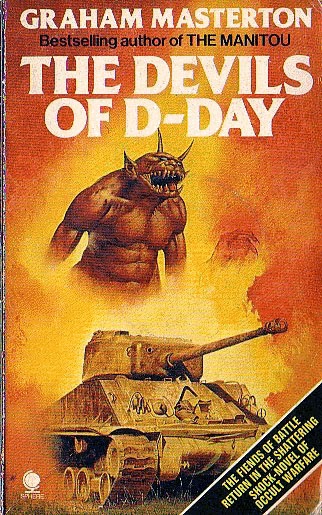
Also ideally filmic was one of the first Mastertons that I read, The Devils of D-Day, a fast-moving and fantastical war story that I have since pushed on several friends… With such a huge back-catalogue, does Graham have any recommendations for anyone who has not read anything Mastertonian? Where could they start?

“I think The Manitou is probably a good place to start,” he responds with little hesitation, “because that was the novel which kicked off my career as a horror writer.  After that I would probably recommend some of the novels I wrote in the 1980s like Family Portrait and Mirror and The Pariah. By the time new readers have digested those, I think they will be pretty well acquainted with the way I write and the directions I like to go wandering off."

The Manitou was a hugely original and influential novel for the horror genre, with very few precedents at the time of publication, it has been followed by four sequels to date. In the Manitou series of stories, the protagonist, Harry Erskine - who was played by Tony Curtis in the 1978 movie version - is  described in the books as a bit like Elliot Gould... so who would be cast in that role now?

John Singing Rock (Michael Ansara) talks 'medicine'
with Harry Erskine (Tony Curtis) in The Manitou
“I think Tony Curtis was perfect for the role, because he played it absolutely straight - as did the rest of the cast. I don’t know enough of today’s young male actors to be able to make a suggestion for a remake.”

How much of the real Masterton is in Erskine?

“Oh, quite a bit, the real Masterton finds it hard to take things too seriously and also reads fortune-telling cards, although I do it for pretty young women for free, rather than rich old ladies for money.”

He seems happy enough to be labelled as a horror writer, and is respected as one, having been awarded some prestigious genre prizes, such as a Special Edgar for Charnel House, a Bram Stoker award for short stories, the Prix Julia Verlanger for Family Portrait. He recently had a park bench dedicated to him in Krakow, where you can sit and listen to an extract from Bassilisk on your mobile device... but having written such a variety of genres, including non-fiction and sex-guides, is there a label he feels is more suitable?
A French edition of Family Portrait / Picture of Evil
which was awarded the Prix Julia Verlanger 
“If I labelled myself as anything, it would probably be ‘journalist’. I was trained as a newspaper reporter and a magazine editor - I have always written to entertain and involve my readers rather than trying to make any personal points or explore my own psyche. To me, writing is my job.”

Does he wear different hats for different genres? (I mean this metaphorically, of course, but privately hope he really does wear a variety of a hats when writing!)

“Obviously there is a difference between the way I write a sex guide and the way I write a horror novel, but when I am writing fiction the genre is unimportant. What is important is making the characters and the settings believable and giving readers the sense that they are participating in the story rather than just reading it. Even with a sex guide I try to be involving and make readers empathise with the experiences of the people I am writing about, and imagine themselves in some of the sexual scenarios which I recommend.”

Is there, I wonder, a personal favourite piece of work that means a lot to him on some level, or that he is particularly proud of?

“I was very pleased by the way Trauma (aka Bonnie Winter) came out. I was originally going to write it under a woman’s nom-de-plume but when I showed it to my agent he persuaded me to publish it under my own name. It tells the story of a woman crime-scene cleaner who is gradually brought to the point of a nervous breakdown by the horrors of her job and her dead-end marriage, and I feel that in this novel I managed to get closer to understanding female thinking than any other novel I had written before.”

Fellow Brit Horror writer, Ramsey Campbell, recounts how people often come up to him and, knowing him to be a horror writer, will say, “I don’t like the kind of books your write,” to which he responds with the questions, “Oh, which ones did you read and not like?” To which they reply, “I haven’t read any of them…” Clive Barker is accused of being in league with Satan… Graham must also be used to dealing with negative responses because of people’s preconceptions?

“My crime novels White Bones and Broken Angels, which have been very successful as Kindle books, did elicit some hostile reactions, mainly because I wrote about murders in a very graphic way. But, after all, murders are horrible and I don’t see any point in pretending otherwise. Real murder is not like an Agatha Christie novel, in which the bishop gets bashed on the head in the bathroom with a badger. It amused me that most of the readers who complained spelled 'graphic' with a double 'f' - ‘graffic’.

"I never read reviews these days, because I know from my experience on magazines that only a tiny percentage of readers ever complain, and so they are not in any way representative of the readership at large. All that counts is how many books are sold... if it’s a lot, then you obviously have some happy and satisfied customers."

His books do often have a level of cruelty and ‘nastiness’, but the characters and stories are also very entertaining and I often find myself chuckling along to dialogue and the ridiculous situations they may find themselves in – to me the horror seems balanced with humour. Is this a deliberate decision?

“It’s deliberate in that I know that people often react to desperate or even grisly situations with humour. It’s our defence mechanism against the unspeakable. Think of the 'Tommies' in World War One who produced humorous magazines like The Wipers Times and made jokes about death and hideous conditions in the trenches.”

…the cat and razor-wire enema from The Sleepless, or the family murdered cruelly in the opening of Black Angel – both books I really enjoyed, by the way, particularly the latter – but does Graham ever think he has ‘crossed the line’?

“I have occasionally ‘crossed the line’, as you call it, on purpose. I have written several short stories which were intended from the beginning to test the very limits of acceptability, such as the notorious Eric The Pie, which led to the banning, by W H Smith, of the horror magazine Frighteners, which I still regret, as it was a very good horror magazine. Then there was Sepsis, which was a Cemetery Dance chapbook, and most recently Beholder, about a little girl who believes that her mother is keeping her imprisoned in the house because she is too beautiful to go out. That will appear in my new collection of short stories Figures of Fear, in October.”

What does he think his readers enjoy in the books, what attracts them to come back?

“I hope when they read my books they feel involved in the characters and identify with their lives and their problems. All of my characters are pretty ordinary people, not super-heroes or knights of the realm, and they often have difficulties quite apart from the evils they have to confront, like business difficulties or a failed marriage or grief. I try very hard to make myself invisible to the reader to create that ‘cinematic’ effect you talked about. This is not nearly as easy as it might seem, because it requires very precise choice of words and an ability to communicate plot essentials without appearing to be lecturing. The late William Burroughs and I spent many hours discussing how to become what he called ‘El Hombre Invisible’. I try to evoke sounds and smells and sensations in my novels to make them feel real, and the greatest compliment that was ever paid to me was by a woman who was reading my Irish crime novel White Bones and said she had to keep looking up from the book to reassure herself that she wasn’t actually in Ireland.”

Graham has been writing professionally for fifty years or so, what is it that still motivates him to write?

“It gives me a chance to tell everybody else what to do. And sometimes that’s a good thing. A retired country doctor in Warsaw said that for years he had prescribed my sex guide Magia Seksu (How to Drive Your Man Wild in Bed) to his patients if they had sex problems.”

Short video: Graham Masterton at a Polish convention  
talking about where his ideas come from

He was instrumental in publishing Scare Care – a collection of horror stories sold to raise money for children’s charities - what wider issues are important to him? What gets Graham angry or ‘fired up’?

“Very few things fire me up except stupidity and ignorance and cruelty and elderly people who dress badly and people who wear hats or caps indoors,” (okay, so he doesn't actually wear different hats for writing each genre…) “Oh, and Banksy and his rubbishy clichéd graffiti. Apart from that, I find it almost impossible to believe that in the 21st century we are still fighting and killing each other, especially small children who have never had a chance to live out their lives. I have seen a great deal of child abuse, and also children who have terrible debilitating illnesses and brain damage, and that is why I put together the Scare Care anthology, which was a collection of short stories by mostly well-known horror authors all of which were donated for free. It raised tens of thousands of dollars for children’s charities in the UK, United States, and several European countries.”

So who are his heroes and heroines?

“People who believe in themselves and stick at what they believe in and take risks. I am helping a young woman to write her first novel and her determination makes me proud of her.”

In many Masterton books, you will find some quite specific art references, to particular works and painters. I gather then that art must be an interest of his – how does creativity from other formats feed into the creative writing?

“I have always enjoyed art and in fact was going to be a commercial artist before I decided to become a newspaper reporter instead. Art can teach you a lot about how to describe a room or a scene or a building or a person. Take a look at paintings by Velasquez, easily my favourite painter. From a distance, they appear immensely detailed, but when you look closer you can see that elaborate lace ruff is just a few splodges of white, and that cherubic face is made out nothing more than some smears of red and yellow ochre. Picasso could do that, too, before he started painting all that Cubist rubbish. Whistler comes a close second...”

To what extent does Graham think that location influences creativity?

“Location is very important as the setting for a story. It has to be utterly believable and feel real. But I can write anywhere. I have written horror stories on the beach in Greece, and sex guides in a cupboard in Stockholm,. When I first joined a newspaper, the reporters’ room with all its manual typewriters sounded like a riveting shop in a Glasgow shipyard, but you soon get used to writing with all that background noise.”

He moved around from Scotland to Ireland to the USA and back – can he still be considered a British writer?

“When I write, I am not aware of having any particular nationality. I set many of my books in the United States for commercial reasons – the whole world is familiar with American culture from films and TV, so it make sense. I am writing a series of books about Katie Maguire the Irish detective at the moment so the inside of my head is completely Irish and I even find myself saying things like: (in blarney accent) ‘if my dog had a face as ugly as yours he’d shave his arse and walk backwards’!”

So when we drink to Graham’s health this solstice weekend, what should we toast him with… a shot of poteen or Irish whiskey? ...perhaps raise a Guinness?

“I have been known to enjoy a Sauvignon Blanc or two, although in Bialystok in Poland recently I spent the whole night until 2:30 in the morning on wild strawberry vodka. It was absolutely delicious and so pure I had no hangover the following day. Many thanks to Adam ‘Tequila’ the barman!”

- and thank you Graham Masterton, Cheers! 


Graham Masterton was talking with Remy Dean

if you enjoyed this interview, you can...


Just out are a new disaster novel Drought - in the style of Plague and Famine - and a new Katie Maguire novel, Red Light. 


A new short story collection Figures of Fear will be published in October and he is currently working on a fourth Katie Maguire novel and when that is finished he promises, “to write a novel so scary that nobody will be able to sleep at night after reading it.”

up-coming release...
More info and news on the official Graham Masterton website...

Friday, 8 October 2010

AB-solutely FAB-ulist: The Heart & Soul Of Clive Barker

Clive Barker is no longer the foremost figure in British ‘horror’. He is the world’s foremost ‘fabulist’, a genre he created for himself that he says stems from folklore, fairy-tales and scripture. He has also fled these shores, having set up home just outside Los Angeles. 

The fame of Barker has grown and grown, from the first cult readership of The Books Of Blood short stories more than two decades ago, to the now world-wide audience that keep his novels in the international best selling charts for months on end. 

Clive Barker photo courtesy of HarperCollins

His more recent works have been epic tales that sweep the reader along from world to world and from one reality to another. Galilee was the novel to firmly establish Clive Barker as a literary presence outside of genre, it is a huge generation-spanning family saga set against the broad canvas of America’s bloodstained history - a little bit of a departure from what his vast audience may have come to expect. Although there is action occurring on supernatural planes, much of the drama is earthbound and human centred. 

So was Barker deliberately trying to come down to earth in order appeal to a yet wider audience? 

“I could not say that I woke up one morning and decided to do this - I don’t have a lot of control over the way my imagination works, it sort of decides by itself. I always had a passion to do a multi-generational family saga. I wanted to do something with a real sweep to it.” 

“I’ve made sure that supernatural stuff is going on in the book, but I can see by the numbers that we were widening the readership as I context these fantastical events in more realistic settings. As I’ve moved more in that direction, my readers have moved along with me…” 

He has turned four of his stories into major movies, Hellraiser, Nightbreed, Candyman and Lord Of Illusion, in addition to the numerous adaptations based on his huge repertoire of short stories. His epic saga, Weaveworld, has been adapted for television as a series, though this project has yet to reach fruition after ten years in development. It did see a transmedia manifestation when it was published back in 1991 as a three-part comic series, adapted by Erik Salzgaber, who has more recently written for the CSI franchise.


On its release, Hellraiser was hailed as heralding the resurgence of British horror cinema... So what happened? 

“The problem is that the Americans stole our thunder. They make these movies so much faster and so much cheaper than we do. I had to go to America for the money to make Hellraiser, I had to for Nightbreed. I went to America to make movies there... there’s nowhere to make my kind of movies here.” 

 Clive Barker made his presence felt in the USA, rapidly earning himself a degree of notoriety and infamy. Hellraiser and especially Nightbreed stirred up plenty of trouble with the MPAA, the American equivalent to the British Board of Film Censors. Are the States a suitable climate for making his kind of movies? 

“They gave us seventeen scenes they wanted cut from Nightbreed... I got four Xs on the movie and I only got one on Hellraiser. Which is bizarre to my mind because the movie is a much mellower and less aggressively horrible movie than Hellraiser. Well both movies are fairy tales.

“What can you say - they’re inconsistent. That is the nature of the censorship game: you never know where they’re going to come from. They’re always going to find something, that you don’t think twice about, bothers them in an incredibly weird way and then something that you think is really gonna cause trouble, they just pass over. There’s no logic or pattern to it and that’s very irritating. 

 “There are people who have suffered it far worse than I have, Cronenberg is obviously an example, but that’s the way it is, you’re dealing with irrational people.” 

What was it like dealing with David Cronenberg - one of Barker’s heroes and one of the horror genre’s most respected directors himself - who starred in Nightbreed? 

“Wonderful, a deeply rational man. He is someone who’s enthusiasm for the genre is not dissimilar to mine in the sense that we both feel that you can do things with the genre which are more than saying ‘Boo’ behind people’s backs. I’ve never been interested in ‘Boo’ pictures, and David isn’t either. You don’t go to one of David’s movies to be made to jump, you get something different, a kind of intelligence and poetry which is missing in most horror movies. 

“And he had a good time making the movie. He said, ‘Hey do I get to come back with worms coming out of my eyes?’ And I said, ‘David, if you want to come back with worms coming out of your eyes, you got it guy, no problem’!” 

It’s not only the MPAA that get worked up over Barker’s fiction and films. We all know that the States are crammed with fanatics and bible-thumpers, but Clive knows this better than most... 

“I get so much mail, some saying I am already burning in Hell - which is an interesting theological notion - but many saying I will burn in Hell, or that I’m the Devil’s child or on occasion I’m elevated to the Devil himself. I get copies of The Bible with passages underlined and so on. I mean the hypocrisy and nonsense of it all, where does one begin?” 

Which of course leads us to believe that these god-bothering people actually read Barker’s books... Does it worry him that there is this fascination with the darker side, which is always a prominent theme in his works? 

“I’m much more concerned that people are interested in the Catholic church. I’m much more concerned that the Catholic church prevents contraception in nations that are spilling over with starving babies. It seems to me that the people who pull on the black magic string don’t look at the organised religions and their horrors anything like closely enough. If you want a really scary religion, look at fundamentalism, in any form.” 

Clive Barker was born and raised in Liverpool, which has a strong Catholic community and culture, how much does he owe to his roots? The accent is now lost and his speech liberally spiced with Americanisms... 

“I never had the accent. Knowing what part of is your roots, what part is your education, what part is genetic, what part of you is self made - those are difficult analyses. It’s a bit like being told by some body that you look like one of your relatives... and you can’t see the resemblance, it may very well be there, but you just can’t see it. And I feel the same about my roots. Maybe I do seem like a child of Liverpool, but I can’t see the resemblance. Your environment makes a mark on you, of course.” 

Ever since the first groups of humans huddled round the first fires, the Shaman has been with us - priest, teacher, medicine man. A storyteller recounting his dreams, tales of spirits and animals in the Otherworld. His dreams would become the dreams of the tribe, their identity.

It is from his dream diary that Clive Barker plucks many ideas and themes for his bizarre creations. His dreams become his drawings, stories, novels, films, and our memories and nightmares. There are many parallels between the state of dreaming and watching a movie in the darkened auditorium. Does Barker parallel himself at all with the Shaman? 

“The whole idea of the shamanistic principle, that the tribe can collectively dream a solution to a problem and that the shaman somehow indicates the direction in which the tribe heads off into their collective unconscious, to pick around amongst the bones of old gods and return with news and indications... that is very easily parallel with what, particularly the writer of the fantastique is doing. 

“The realist, the writer of naturalist fiction, is necessarily bound, by definition. The fantasist says, all right, I can write about divinity, semi-divinity, demons, gods and spirits of air and water or stone. I can write about human beings, sane, crazed, visionary, even dead and I can write about them all in landscapes that are very realistic or very unrealistic. I can write about them in states of mind which are also worlds unto themselves. 

“So when you’ve got that range of possibilities, reality dissolves, which I think is a dreamstate in a way because in our dreams we also meet the dead, we commune with gods and spirits. Whether we literally do that is an issue which I haven’t resolved for myself. I’m tempted to think that sometimes we do, that there is a literal sense in which in certain states of consciousness, dreaming, trance states, drug states, any altered states, I think it’s very possible that in some instances we are actually communicating with entities other than human, at least other than living human. 

“But even putting aside that possibility - which I realise marks me as a crazy - let’s just assume that this is all the mind’s creation. Even under those circumstances, in dreams we are learning from our subconscious, which is, to take the realist view, representing itself as the dead or the semi-divinities in order to instruct us. We are learning from those forms and forces in symbolic form, and we are growing by the exchange.” 

The Shaman was the most respected of the tribe, he has a great power, but little wealth. Is it the power or the wealth that motivates Barker? Does he find himself exercising restraint in his fiction to comply with what his now vast audience want to see? 

“I don’t know what they want. They seem to be willing to take me at my most extreme. Which pleases me. Great And Secret Show doesn’t soft pedal any of its themes, which are very difficult. There is some strange fantastical stuff, the odd sex, some very violent material, it’s a big book and so on... Yet it was one of the most popular books in terms of number of copies sold that I’ve done. So I don’t think about my audience in the sense that I think, ‘Oh, I’d better not do that - it might turn them off’. 

“With movies it’s a different thing. You’ve got the constant problem of the MPAA and the BBFC and so you’ve got people telling you that you can’t do this... but in books it never occurs to me to mellow what I do... 

“As for motivation... I got through my twenties without earning a dime and not worrying about it. Money has never been a motivation. 

“It is very important for me to produce - to make things that don’t resemble other people’s things. Not just for my audience’s sake but for my own so I don’t bore myself... It’s important for me to have the power storytelling gives. There is something very wonderful about holding someone enthralled, just as there is something wonderful about being held enthralled. 

“I love to be told a story, I love to be in the middle of a movie and know that this movie’s got me. Not just fantasy stories, it’s all kinds of stories... The story is about what happens next. That’s what the kid wants to know when he’s told a story, ‘What happens next?’ It’s very primitive, very simple. And I love to have that done for me. 

“I hate knowing what is going to happen next. My problem with most Hollywood movies is you always do. There’s a terrible predictability about most movies, particularly horror movies. You enter most movies knowing who’s gonna live or die, knowing what the division of good and bad is, knowing who you’re going to end up caring for and who you’re not. 

“I have nothing in my life but work - that may sound like a trial, but it isn’t. I desire nothing in my life but the making of stories on the screen or on the page, and it obsesses me.” 

Clive Barker has more than enough to keep himself busy... In addition to creating and writing his ‘fabulist’ tales – currently concentrating on the Abarat series that he also illustrates – he has ventured deeper and deeper into the world of Hollywood and film production. He was Executive Producer on the 1998 film, Gods And Monsters, the critically respected biopic of cult horror director James Whale. Dread, adapted from Barker’s short story by Anthony DiBlasi was released in 2009 and there are two more movie manifestations currently awaiting release: The Thief Of Always, scheduled for 2010, and Tortured Souls, adapted from his own Hellraiser-linked short story and being directed by Barker himself … and he tells us that he intends to, “get on with the business of making movies on a case by case basis...” 

Then, after a short pause, he adds, “But I don’t take movies as seriously as I take books. And never will.” 


- Clive Barker was in conversation with Remy Dean.